


Hacks Season 4 Design: From Palanquin to Power Desk
As the Emmy-winning comedy series Hacks returned for season 4, Deborah Vance (Jean Smart) makes her late-night debut—launching herself and Ava into a new world of television, performance, and reinvention. For production designer Rob Tokarz, that meant building a one-of-a-kind late-night stage and backstage that reflected the blend of who Deborah is as a person, her journey throughout the seasons, and late-night as an institution. On top of that, Rob and his team also needed to custom-build unique props like a palanquin, plan and execute faux kitchen destruction, and—yes, you heard that right—take Hacks international… for the first time to Singapore.
Discover more about the Hacks Season 4 design—from bold late-night sets to luxe dressing rooms, and take a look behind the scenes with the photos below.
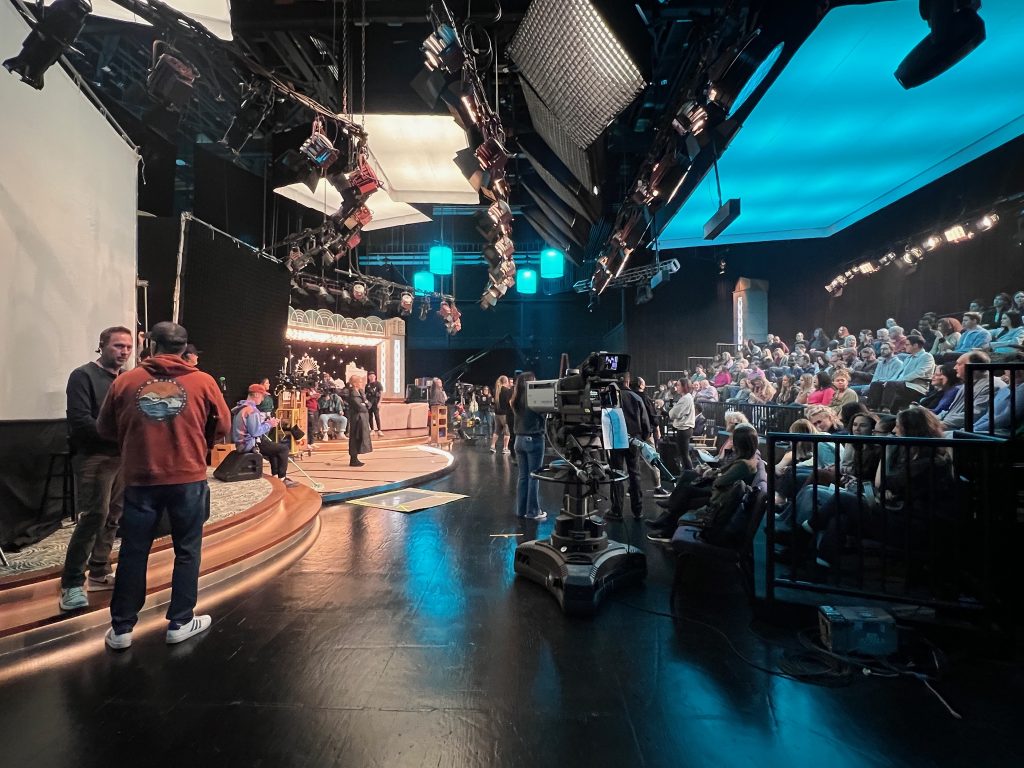
Film and Furniture: This season of Hacks was unique because Deborah Vance became the first-ever female late-night show host. How did you approach creating the late-night show set, blending the world of late-night and who Deborah is as a person?
Rob Tokarz: What worked to my advantage was knowing the late-night set was coming at the end of Season 3. I had the opportunity to live with the concept for months between seasons and approach it with real clarity. The goal was to design a set that reflected both Deborah Vance and the legacy of late-night television. Deco has always suited Deb, and it also helped root us in L.A. I looked to the Griffith Observatory and the Eastern Building for inspiration—pulling shapes, finishes, and a sense of grandeur.


We included nods to Deborah’s career throughout: the backdrop silhouettes trace her journey from Vegas to L.A.; the star drop echoes her Palmetto residency in Season 1; and the chevron flooring references both her tour bus and Las Vegas mansion. Footlights reflect off a marlite floor—another callback to her stage history. We added an arch detail from Johnny Carson’s 1972 Burbank set, marking her entrance into the legacy of late night, while the marquee lights behind her nod to her Vegas roots.
Through massive collaboration with Adam Bricker, our DP, we developed the insane number of show lights above. Our fixtures department installed nearly 1000 feet of LED strip light integrated into the set. We wanted the stage to feel like a jewellery box—distinctly hers and visually striking.

F&F: We also see the late-night set evolve – Deborah’s desk goes through some changes, one of the episodes features a palanquin, and Deborah even plays cards with her guests on stage. Can you walk us through some of those elements? Are there other ways in which the late-night set evolved?
RT: Bits are essential to the DNA of late-night, and we knew Deborah would need them to fully inhabit that world. For the palanquin, we scouted every prop house in town but found nothing that felt right, so we designed one from scratch. It had to echo Deborah’s costume and the tone of the show, feel Roman and theatrical, but also be lightweight enough to be carried and sturdy enough for Jean to feel comfortable.
We built a custom frame out of metal tubing and capped it with our finishes, matched the upholstery of the mattress and pillow to her Late Night curtains, and draped it with a diaphanous light-colored fabric. What you don’t see is that we even hid D-rings for safety harnesses, if they needed them.


For Mayor Jo’s Zamboni, we imagined what a real late-night art department would do with a single night to prep a gag. Working from one of my sketches, our construction team built it from white foam core, white tape, and blue vinyl —mounted over a propane-powered floor sweeper sourced by our Transportation Department.

Another evolution was the subtle change to the skyline behind Deborah’s desk. Working closely with our DP, we adjusted surface treatments and finishes on the buildings to expose them beautifully on camera. All of this mirrors how real late-night shows evolve during their runs—sets get adjusted, scenery gets refined, lighting gets dialed in. We wanted ours to feel just as lived-in and responsive. We even tracked changes in her desk throughout a shoot day—swapping out the panel mid-day depending on whether we had taken a saw to it yet. While we had the luxury of knowing ahead of time what was coming, it still felt “real” to us, as often the amount of time we had to execute changed (read: shrank) regularly.

F&F: Let’s move backstage and to the offices. What was the process like designing Deborah’s dressing room? Similarly, when the season starts, Ava’s office is pretty empty, with just a desk; how did her space evolve the longer she stayed at late-night?

RT: When designing the offices and all of our backstage elements, we played with the tension between public and private. The stage is the most public space, but the dressing rooms and offices sit somewhere in between—functionally private but still part of the machine. Our guest dressing rooms wanted to have that fun, vibey energy of the stage, while the production spaces wanted to stay neutral and functional. I selected a blue paint colour to help marry the spaces together.


We wanted Deborah’s dressing room and touch-up space to mirror each other in tone and reflect her identity. Jen Lukehart, my set decorator, and her team, sourced incredible furniture, and I selected finishes that spoke to those pieces. We painted the room in lavender and found a beautiful textured gold wallpaper that we glazed to create a space that felt uniquely hers.

Ava’s office started intentionally stark—just a desk and a chair, much like the production offices of any show. You are given the bare bones and then the show takes over. As the season progressed, it evolved visually to reflect how the job was taking over her life. Jen’s team slowly layered in clutter, fatigue, and personal touches that built up in a way that felt honest and grounded.

F&F: Early on in the season, Deborah gives in to her frustration and does some damage to her kitchen – can you walk us through how it was achieved? Are there any changes/additions to the house this season?
RT: The kitchen demolition scene was one of our biggest early challenges. The house was a Spanish Revival home in Altadena. Both gorgeous and historic, the homeowners wanted us to keep it that way. We’d shot there over the course of the last three seasons and were familiar with the kid gloves we needed to wear at all times.
Our showrunners, Lucia, Paul, and Jen, wanted our input to see what we could offer in terms of maximising destruction on location. My Art Director, Jeanine Ringer, and Construction Coordinator, Drew Schultz, led R&D to prototype smashable elements. We built flats to cover existing tile with bisque tile that would shatter cinematically, layered a breakaway butcher block over the original counter, and constructed lathe-and-plaster flats to cover their existing lathe-and-plaster walls. Wherever we could, we tucked in extra dust and debris so each smash was that much more cinematic. We tested every piece, filmed it, refined it, and eventually staged a full-scale mockup with Jean that went as smoothly as we’d hoped.
We built three full destruction rigs—though we only ended up using one. I then ran the entire process by our homeowners and laid out all the ways that we were going to protect their home. Drew’s team did an incredible job ensuring no damage occurred. What you saw was the first and original rig, and all was accomplished with a rubber sledgehammer.
F&F: Like previous seasons, Season 4 features some beautiful mansions. Are there any houses/ mansions that were your favourite or a challenge to scout and/or adapt for the needs of the show?

RT: One of my favourites this season was Bob Lipka’s house—a stunning Paul R. Williams estate. Williams was the first Black member of the AIA and designed over 2,000 homes in L.A., including those for Frank Sinatra and Lucille Ball. Interestingly enough, we scouted his Sinatra House as another option. He famously learned to draw upside down to accommodate white clients during a more segregated Los Angeles. The house we used had sprawling lawns, levels, and classic Hollywood glamour—something that needed to convey the scale of someone of Bob Lipka’s stature. It didn’t hurt that we were in the same neighbourhood as David Zaslav.

FF: One of the most ambitious aspects of Hacks Season 4 design was taking the show international—enter Singapore! What was the scouting process like, and how did you design sets in the finale to match Hacks’s tone and feel while at the same time reflecting the environment as the show moves abroad for the first time? Do you have a favourite set in Singapore? How did you achieve it?
RT: Shooting in Singapore was a once-in-a-career experience. A small group of us—our Director of Photography, our 1st AD, and two of our producers—traveled there in December to scout. At one point, we were in the middle of the Bay at night on one of the bumboats, and I had a moment of complete awe that I was able to be a part of this. During the course of our week there, I believe we ended up in enough elevators to look for rooftops that we easily cleared a thousand floors traveled vertically. Our goal was to lock down the right combination of choices in order to match the beauty and intensity of the script. We then returned several days before shooting to review our final choices with Lucia then tech scout the whole thing.

For me, the most substantial space was the theater where Deborah performs. Even though she was abroad, it still needed the scale and grandeur of a Deborah Vance headliner. We landed at the Victoria Concert Hall, which gave us immense historical value. The challenge was to create our set with a team that was working basically opposite hours from Los Angeles for a space that we didn’t have great access to—and we willed a design into existence.
We wanted to keep the focus on Deborah, so we masked off most of the stage in red curtains, and I developed the half-circle focal point as a nod to Chinese folding fans. Once we had that, there was a realisation that we needed another design detail to finish the piece. Again, this incredible team was able to pivot on the short time frame and trimmed out our fan with an analogous fabric tone that made it pop off-screen. It wanted to feel bold and unlike any space we’ve seen her perform in—but feel at home in the Hacks-iverse.
From palanquins to performance halls, Hacks Season 4 design is a showcase of smart, story-led design. Rob Tokarz and his team have created spaces that not only reflect Deborah Vance’s rise but also celebrate the craft of production design—proving once again that every detail matters.
Where can I watch Hacks Season 4?
Hacks Season 4 is available to watch in the UK on Sky Max and NOW. All episodes are available to stream on demand. If you’re a Sky subscriber, you can access the series via Sky Max. Alternatively, NOW offers streaming access with an Entertainment Membership.
In the US, Hacks Season 4 is available to stream on Max (formerly HBO Max). You can subscribe directly or access it through platforms like Amazon Prime Video Channels.
Season 4 premiered in April 2025 and consists of ten episodes. It continues to receive critical acclaim for its sharp writing and standout performances. A fifth season has been confirmed and is expected to premiere in Spring 2026.
Sponsored post
This feature is FREE to Classic members.
Join our newsletter community to receive Film and Furniture inspiration direct to your inbox and we’ll UPGRADE you to Classic Membership (which includes access to our exciting giveaway draws) for FREE.









 Facebook
 Twitter
 Instagram
 Pinterest
 RSS
RSS