


2026 Film Awards Part 2: The Oscars and BAFTAs from a design perspective
This year, the Oscar and BAFTA Production Design categories have landed on an identical shortlist — an unusually neat overlap that suggests a strong international consensus on what cinematic world-building currently looks like. Are the Academy Awards and the BAFTAs “the same”? Not quite. Their voting bodies differ, and their wider nominations reflect distinct cultural priorities. But in this category, they are reading the season in strikingly similar ways.
Production design is the art of building a world that actors can inhabit and audiences can believe in. It encompasses locations, architecture, interiors, furniture, material culture, props and atmosphere — all underpinned by rigorous research. Together, these elements form the physical framework in which story, performance and camera movement are able to exist. When it works, production design does far more than decorate. It reveals class, ambition, nostalgia, emotion and power. Rooms remember things.
For Film and Furniture, that alignment allows us to look beyond the horse-race and ask a more interesting question: what kinds of spaces are being rewarded — and why? These are not showy designs, but spaces built for emotion, behaviour and story.
The Oscar and BAFTA Production Design nominees
Hamnet
Production Design: Fiona Crombie
Set Decoration: Alice Felton
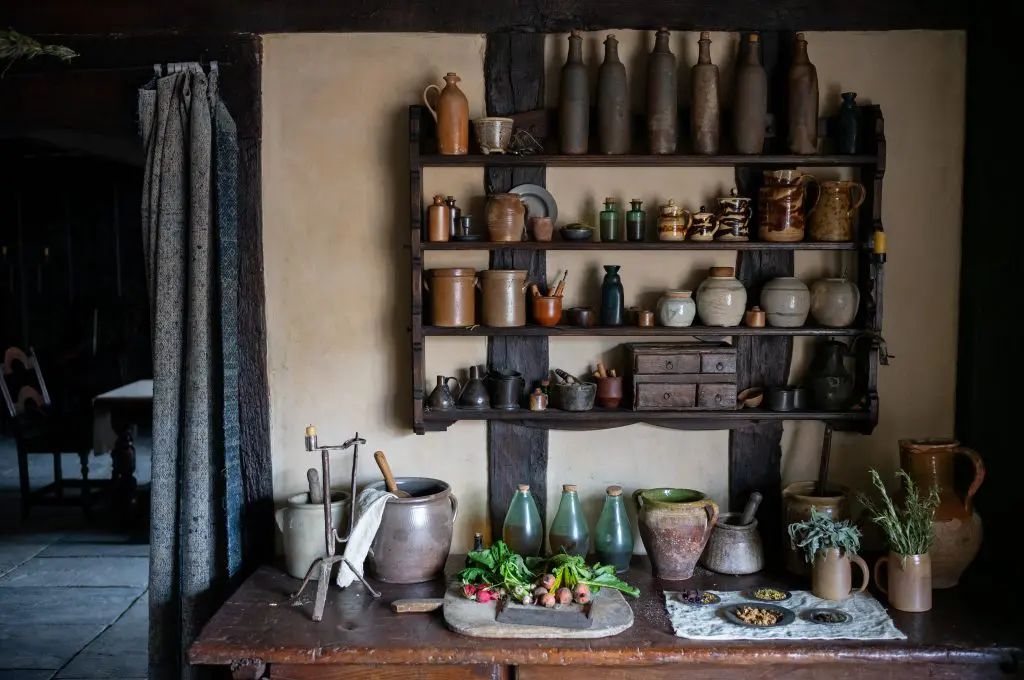
At the centre of this year’s design conversation sits Hamnet, a film in which forests, houses, theatres and domestic interiors are inseparable from emotion and memory. Wood, plaster, stone, candlelight and cloth are treated as psychological architecture.
Key houses and locations
• Agnes’s family farm (Hewlands): Filmed at Cwmmau Farmhouse, Whitney-on-Wye, Herefordshire — a grand Jacobean farmhouse surrounded by farmland, woodland and meadows. Its rooms feel shaped by labour and weather: low light, rough surfaces, working hearths.
• Shakespeare’s Henley Street house: Built from scratch at Elstree Studios, using reclaimed timbers and hand-aged finishes. Narrow passages, low ceilings and an A-frame attic bedroom create a pressurised, crowded domestic interior.
• The Globe Theatre: Reconstructed at 70% scale at Elstree, conceived as “like the inside of a tree” and formed from reclaimed oak.
Furniture and objects
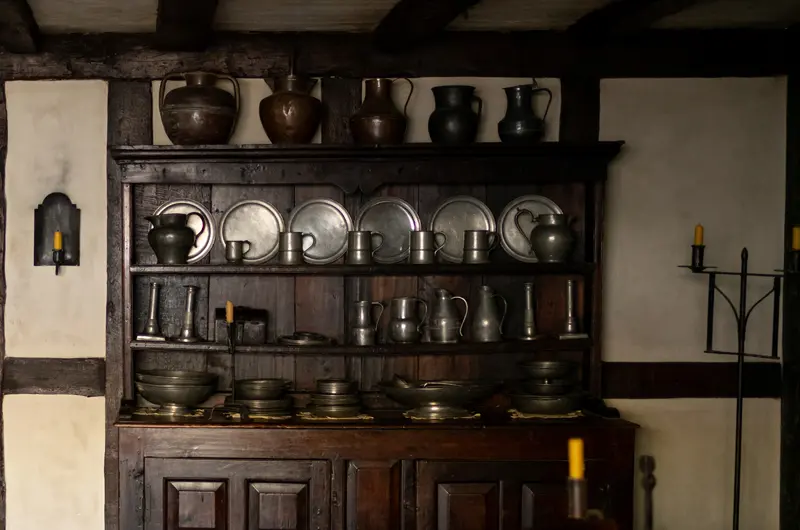
Many of the 16th-century beds, tables and storage pieces were made anew using traditional joinery because everyday period furniture rarely survives. Beeswax candlelight dictated reflective choices: pewter plates and hand-blown Somerset glass register emotional shifts. Colour operates as code — warm reds in the family house drain to cold blues and purples after Hamnet’s death.
Awards context
Eight Oscar nominations (including Best Picture, Director, Actress, Production Design, Costume) and eleven BAFTAs (including Best Film, Outstanding British Film and Director).
Discover more about the houses and objects of Hamnet in our Video Podcast with the film’s designers Fiona Crombie and Alice Felton.


Frankenstein
Production Design: Tamara Deverell.
Set Decoration: Shane Vieau
A gothic world built from intention rather than nostalgia, Frankenstein draws on a lineage of laboratories, castles and marginal dwellings while avoiding museum-piece pastiche. The interiors feel carefully stitched together from industry, decay and craft.
Key spaces
• The laboratory: Defined by a green-on-green patina of corroded copper piping and oxidised metal, the lab reads as a working engine room rather than a theatrical set.
• Edinburgh exteriors and interiors: Rendered in greys, signalling urban severity.
• Ancestral interiors: Marble and gold articulate inherited wealth and social power, standing in contrast to the rawness of Victor’s working spaces.
Furniture and fittings
Several key objects carry the film’s thematic weight. The Medusa wall sculpture becomes a visual emblem of the “misunderstood monster”, linking mythological punishment to Victor’s creature and the consequences of reckless ambition. The Evelyn Tables — replicas of 17th-century anatomical preparations from the Hunterian Museum — are among the film’s most haunting pieces, with real human nerves and arteries varnished onto pine boards.
Much of the laboratory’s cluttered apparatus nods directly to Bernie Wrightson’s pen-and-ink illustrations of Mary Shelley’s novel: glass spheres suspended in nets, layered instruments and improvised shelving. Dominating the space are four 15-foot “Edison Battery” towers in green glass — fully functioning props with internal lighting, steam and moving dials to simulate circulating life fluids. Elsewhere, ornate Victorian dressing tables and vanity mirrors recur as motifs of identity and doubling.
Awards context
Nine Oscar nominations and eight BAFTA nominations.
-

Guillermo del Toro Cabinet of Curiosities: My Notebooks, Collections, and Other Obsessions
As seen in:Director: Guillermo del Toro
Shop NowFrom Hellboy and Pan’s Labyrinth to The Shape of Water, Guillermo del Toro has built worlds rich with imagination, symbolism and exquisite design. This beautifully produced volume opens his private sketchbooks and personal collections, revealing the drawings, ideas and obsessions that have shaped his darkly poetic universe.
Marty Supreme
Production Design: Jack Fisk
Set Decoration: Adam Willis
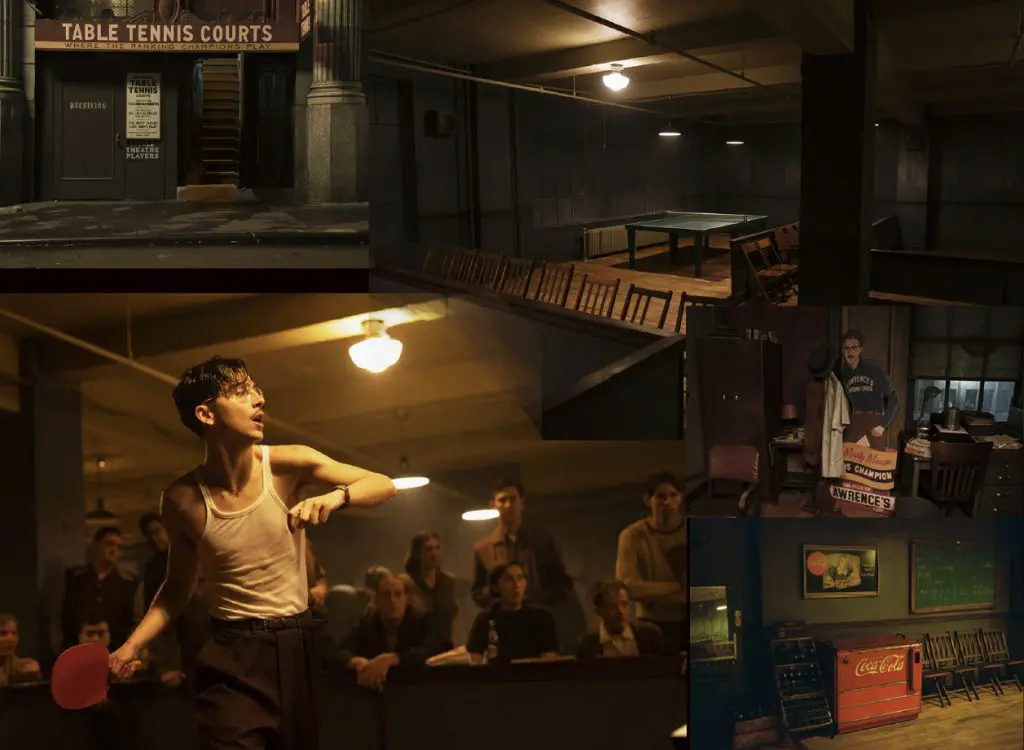
This is production design working quietly. Fisk reconstructs 1950s New York and Japan as functional worlds of work and competition.
Key interiors
• Ping-pong parlours and training spaces: Lawrence’s Broadway Table Tennis Club was recreated from blueprints and archival film, complete with hand-painted landscape murals (originally made for the indoor golf course that once occupied the site) and period Coca-Cola machines.
• Marty’s early workplace (the shoe shop): A modest but eye-catching retail interior in browns, greens and oranges that anchors him in everyday labour.
• The Woolworth Mansion (Kay Stone’s world): Used for the character played by Gwyneth Paltrow, this location represented “practical grandeur”. The crew built independent lighting rigs so as not to touch the $38 million property’s historical walls.
Furniture and objects
Furniture throughout the film is functional rather than expressive. In clubs and training halls, ping-pong tables, benches and lockers dominate, while sporting equipment is treated with equal precision — from hardbat paddles to smaller, correctly scaled 1950s ping-pong balls.
Alongside the arenas and clubs, Fisk also gives weight to smaller domestic spaces. Marty’s parents’ apartment is tight and worn-in, defined by practical furniture and limited room to expand, while his rented hotel digs — the room where the ceiling collapses — is intentionally flimsy: a temporary interior that mirrors his precarious position in the world.
Awards context
Nine Oscar nominations; eleven BAFTA nominations.
And it also wins the Film and Furniture award for best film marketing, thanks to Timothée Chalamet’s mock promotional Zoom meeting — a piece of performance-art publicity that felt as carefully designed as the sets themselves.
-
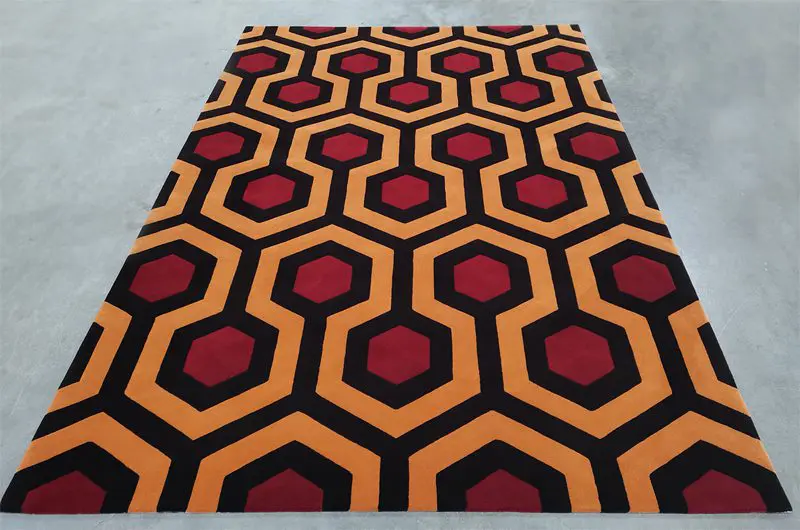
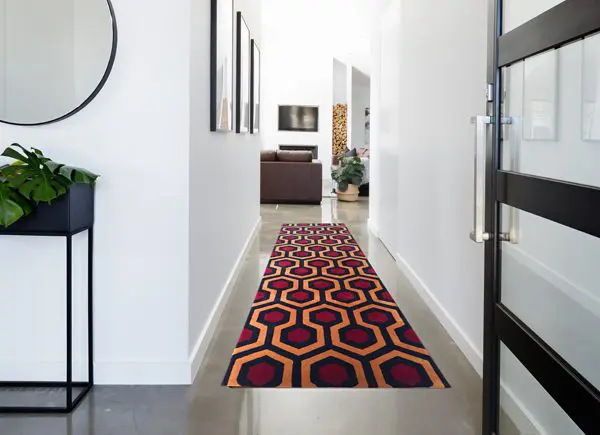
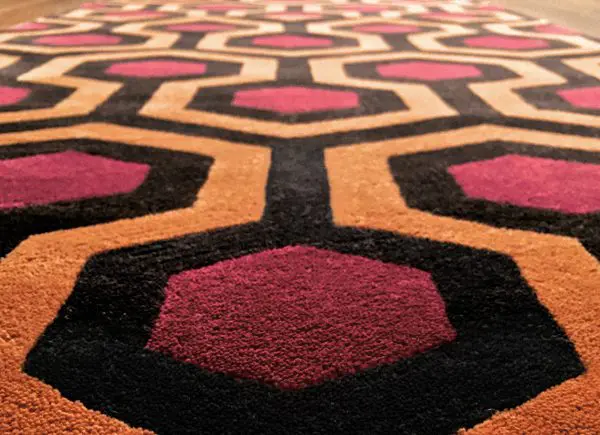
Hicks’ Hexagon officially licensed luxury rugs and runners, designed by David Hicks, as seen in The Shining Overlook Hotel
Designer: David Hicks
Film and Furniture
Directors: Stanley Kubrick, Steven Spielberg, Mike Flanagan
Shop NowOfficially licensed Hicks’ Hexagon rugs and runners as seen in The Shining‘s Overlook Hotel (original design by David Hicks). High quality, custom made, hand tufted 1 ply wool. One of the most iconic carpets in film
Approx Price range: £1,572.00 through £7,342.00 Inc VAT if applicable / $2106
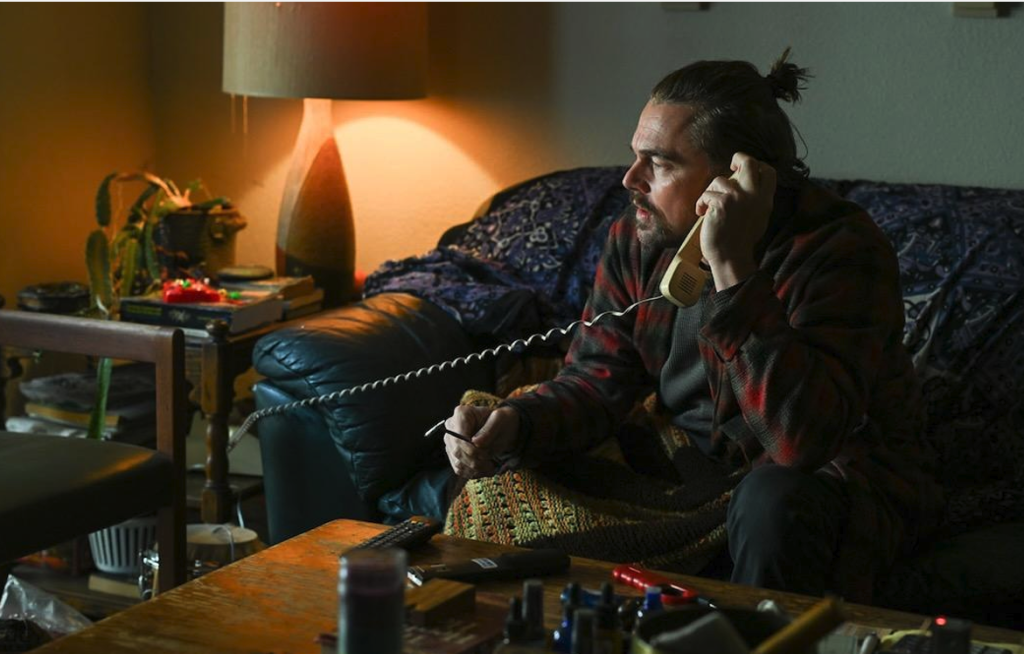
One Battle After Another
Production Design: Florencia Martin
Set Decoration: Anthony Carlino
In One Battle After Another, production design operates at ground level. Florencia Martin builds a world of improvised shelters and psychologically charged interiors that reflect a life spent hiding, moving and resisting — a chain of spaces (cabins, tunnels, apartments and underground rooms) that maps a life lived between structures rather than comfortably inside them.
Key houses and interiors
• Bob Ferguson’s forest cabin (Kneeland): A one-bedroom cabin designed to feel deliberately cramped, mirroring Bob’s sixteen years of isolation. Although the exterior is real, the interior bedroom and a 60-foot hand-hewn tunnel were built on a soundstage in Los Angeles.
• Sensei’s apartment, El Paso: Built above a real shopfront, Genesis Perfumeria, this second-floor apartment was constructed as a fragmented interior. Walls are stripped back, floorboards ripped open, and rooms interlock like a maze. Characters pass through neighbouring flats as if they were one continuous dwelling – a shared survival network.
Furniture and atmosphere
Nothing feels styled. Furniture is local, mismatched and practical — sourced regionally in El Paso and Northern California so each interior carries its geography. Fridges work. Ceiling fans spin. Actors grab drinks mid-scene because the spaces are fully functional. Tables are surfaces of action rather than symbols of taste. The film’s visual language draws on 1970s American thrillers — harsh contrast, imperfect exposure, and natural light wherever possible.
Awards context
One Battle After Another has serious awards momentum: 14 BAFTA nominations and 5 Oscar nominations, including Best Picture and Best Director.
Sinners
Production Design: Hannah Beachler
Set Decoration: Monique Champagne
In Sinners, tension is built through space and material rather than decorative display. Set in the Jim Crow–era Mississippi Delta, the film centres on spaces built to hold threat rather than style.
Key locations
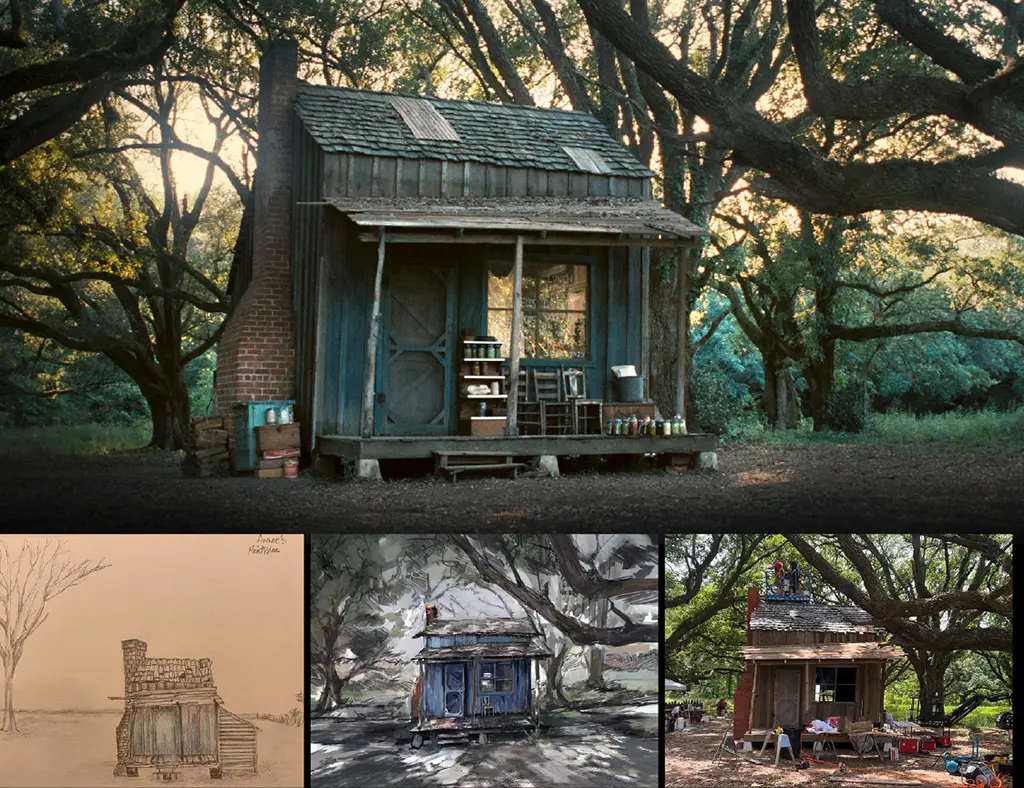
• Annie’s store: A small home beneath a canopy of oaks, painted haint blue to ward off spirits (filmed at Creedmoor Plantation, St Bernard Parish, Louisiana).
• The Juke Joint (a converted sawmill): The narrative hub, built at Hidden Oaks Golf Course, Braithwaite, Louisiana — a timber structure with improvised bar and stage.
• The church: A recurring refuge that frames the story’s moral edges.
Furniture and fittings
Rough timber benches, makeshift counters and simple platforms for musicians — minimal means, maximal tension.
Awards context
Ryan Coogler’s Sinners arrives as a major awards heavyweight, with a record-breaking 16 Oscar nominations and 13 BAFTA nominations.
The ones that got away
Not every well-designed film made it onto the official Oscars and BAFTAs Production Design shortlist. We’ve pulled together a separate piece on the most interesting omissions and near-misses — films where houses, furniture and interiors still do vital narrative work, even without a nomination.
Read our companion article: 2026 Film Awards Part 3: Oscar and BAFTA Production Design Snubs
Looking ahead
With the Oscars and BAFTAs reading the design landscape in the same way, this season offers a snapshot of what production design is currently being rewarded for: psychological interiors, authored worlds, and spaces that serve character.
At Film and Furniture, we’ll continue to follow BAFTAs and Oscars 2026 through a design-led lens (especially on our Instagram) — looking beyond nomination tallies to examine how houses, rooms and furniture shape story. Because the most interesting design work is rarely the loudest. It is the work that quietly changes how a film feels.
Where can I watch the Oscars (98th Academy Awards)?
Sunday 15 March 2026
USA: ABC and Hulu (live stream) – 8:00pm ET / 5:00pm PT
UK: ITV (delayed broadcast) – 1:00am GMT (early hours of Monday 16 March)
Where can I watch the BAFTAs (EE BAFTA Film Awards)?
Sunday 22 February 2026
UK: BBC One and BBC iPlayer – 7:00pm GMT
USA: BritBox – 2:00pm ET / 11:00am PT
This feature is FREE to Classic members.
Join our newsletter community to receive Film and Furniture inspiration direct to your inbox and we’ll UPGRADE you to Classic Membership (which includes access to our exciting giveaway draws) for FREE.







 Facebook
 Twitter
 Instagram
 Pinterest
 RSS
RSS