


The design, furniture, art and handmade worlds of Teenage Sex and Death at Camp Miasma
In Teenage Sex and Death at Camp Miasma, a queer director is making a sequel to a cult slasher franchise and becomes obsessed with casting the original film’s “final girl”, drawing both women into a world of psychological and sexual chaos.
That world is as strange and seductive as the story itself. Rather than relying on CGI, production designers Brandon Tonner-Connolly and Matthew Hyland layered handmade artwork, vintage furniture and locally sourced antiques with one of cinema’s oldest visual crafts: matte painting.
They created an entire fictional slasher franchise, transformed remote former summer camps into a home, cinema and artist’s workshop, and developed the distinctive artworks made by Gillian Anderson’s character Billy.
Following the film’s warm reception at the Cannes Film Festival earlier this year, Film and Furniture spoke to Tonner-Connolly and Hyland about creating the richly layered interiors of Teenage Sex and Death at Camp Miasma on an indie budget, sourcing much of its furniture locally on Vancouver Island, designing a convincing 1980s horror film within the film, and reviving an old-school cinematic technique for the screen.
Creating Billy’s extraordinary artwork
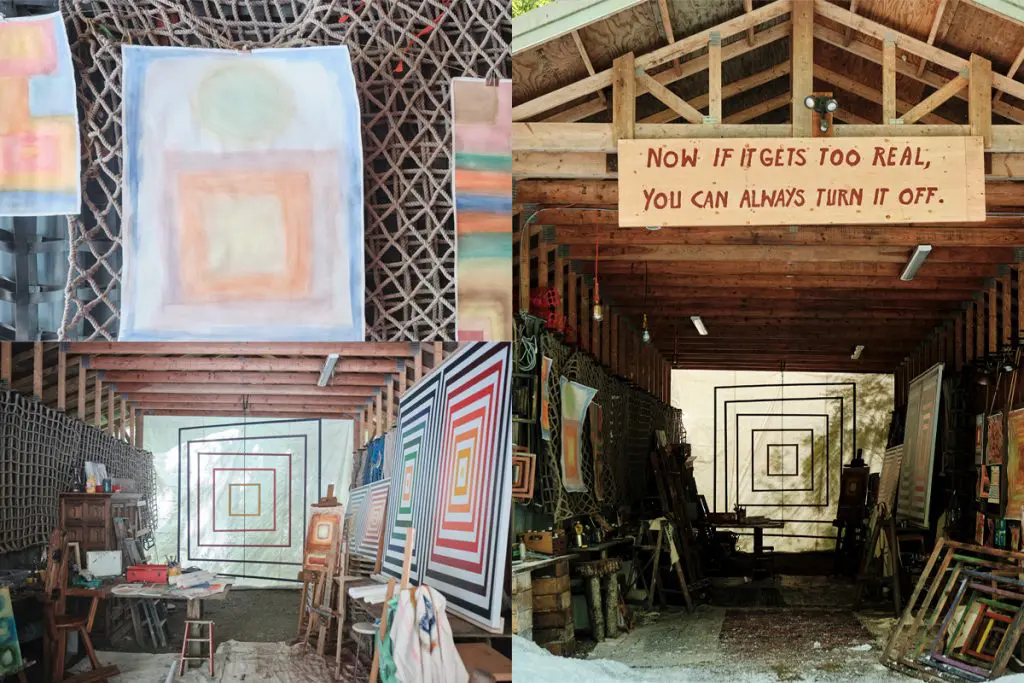
Film and Furniture: Billy, Gillian Anderson’s character, is an artist. Can you walk us through working with an artist to create an artistic persona for her character and specific art pieces, including the large canvas?
Brandon Tonner-Connolly/Matthew Hyland: Billy’s artwork is a way for her to process the trauma of her experience on the original Camp Miasma film. She repeats concentric square shapes, the shape of Little Death’s mask, in different mediums, in different forms, trying to unravel it for herself.
It started, as it always does, with research. We found artists we liked who, even if they weren’t making this exact art, had an aesthetic that spoke to Billy’s character. Josef Albers, Vera Molnar, and a friend of director Jane Schoenbrun‘s who worked with circles in watercolors. Not just paintings, but sculptures, woodworking, any medium you could imagine. We wanted to convey how much time Billy spends alone out there creating. Even though she’s primarily a painter, she would’ve worked her way through other mediums.
Rather than have the Scenic department recreate mock-ups, we wanted to find an artist who rang true to the character and collaborate with them, allowing some room for the unexpected. We auditioned a few people, landing on Vancouver sculptor and scenic artist Joel Rodriguez. He was great, always pitching even bigger, crazier ideas, like a 10-foot-tall sculpture, and we were like, “let’s just please start with getting an 8×10″ drawing done.” We went back and forth until he came back with work that felt like the character, and then we felt comfortable giving him the room to run.
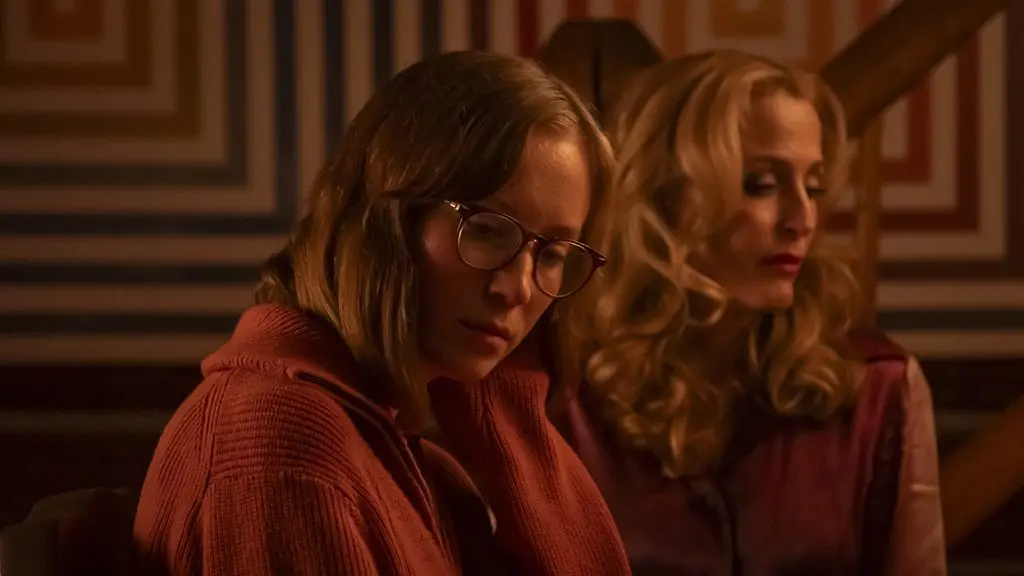
Jane had a vision of a gigantic, almost disorienting square within square painting on Billy’s cabin wall during the dinner scene, when Billy and Kris are first getting to know each other. There’s so much happening in the scene psychologically, and the painting wouldn’t be revealed until about halfway through, and then you’d realise, Oh, Kris has been in the shadow of this insane piece of art the whole time.
Our design relied on extremely precise measurements and colour combinations to achieve a vortex effect, pulling the viewer into the squares. But we couldn’t make it until we had a location and a corresponding wall size. That left very little time for painting, with Joel pulling all-nighters to meet the deadline, and even less for transport, with us scrambling to arrange a ferry to haul our now 8-foot-tall canvas to Billy’s Cabin on Vancouver Island. We didn’t know if the vortex effect would work until it was all there, drawing the viewer and Kris deeper into Billy’s world.
Camp Miasma production design: transforming two summer camps into one world
F&F: How did you design a former summer camp turned home and cinema?
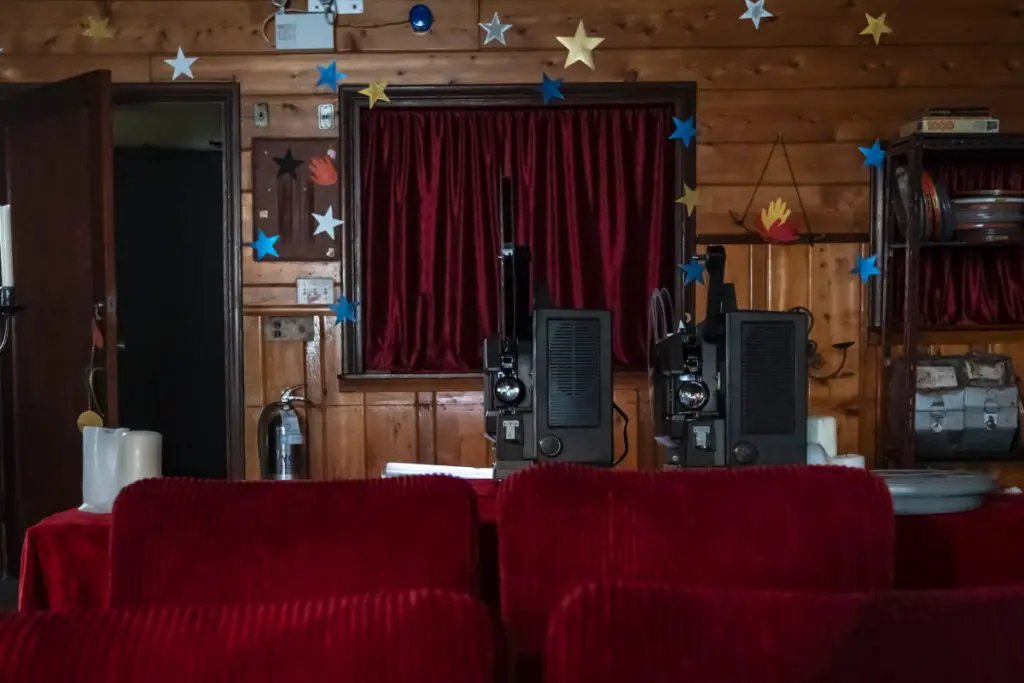
BTC/MH: It all starts with the location, and, unfortunately, everything we needed for the film was spread far and wide across a remote and heavily forested island off the coast of Vancouver.
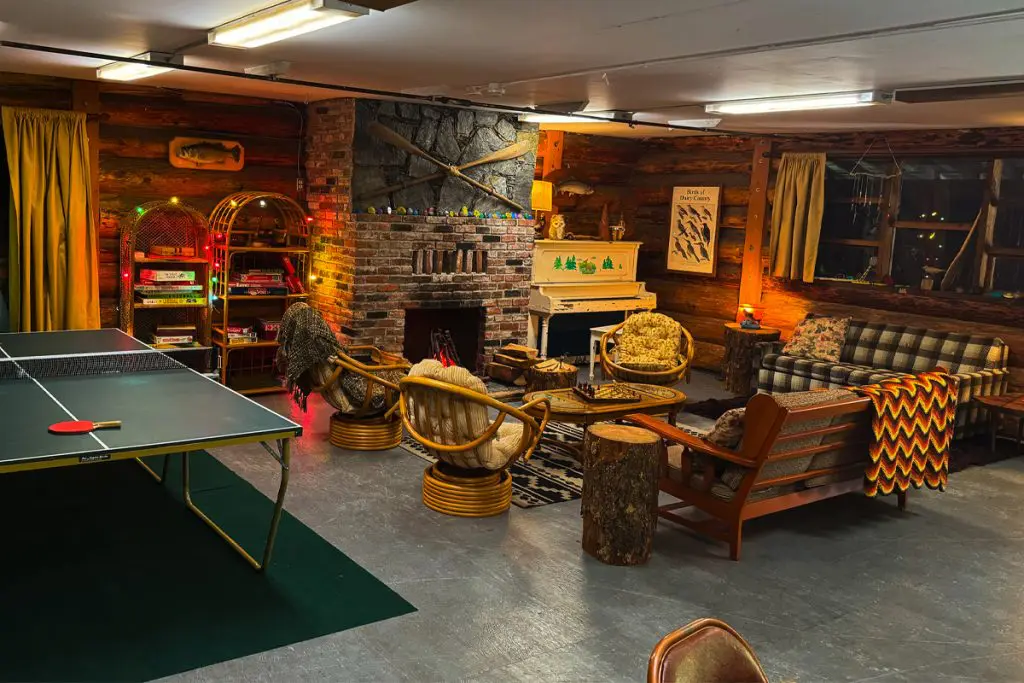
We used two different summer camps that happened to be on opposite ends of the map. It turns out Vancouver Island doesn’t have the type of iconic sleepover camps Jane had in mind when they wrote the script, so we keyed in on all the small details we needed to add or change: trail markers, camp activities, door hardware, and unifying color choices. Keeping those consistent across both locations also helped sell the illusion that it was all filmed at the same place.
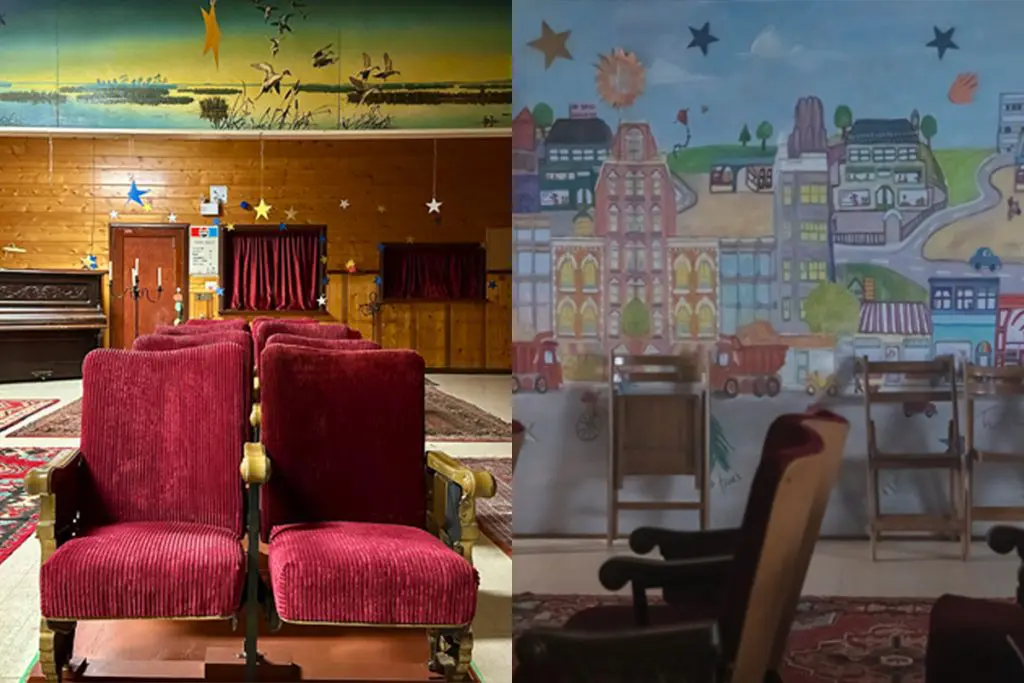
Once we had the summer camp layer though, we needed to build Billy’s world on top of it. For the cinema, this meant using an existing community rec center for the interior and transforming it into the camp’s arts and crafts building. We added walls to reshape the space, which were matched to the existing rustic finishes, and expanded them out to include a small stage for Billy’s projector screen.
We then added a wall-sized mural of a cityscape done in the style of a children’s book illustration. We conceptualized it as something the camp art teacher had painted with the campers. We placed small details throughout the space, like a shelf of board games, a lending library, and an upright piano that the campers might turn to on rainy days.
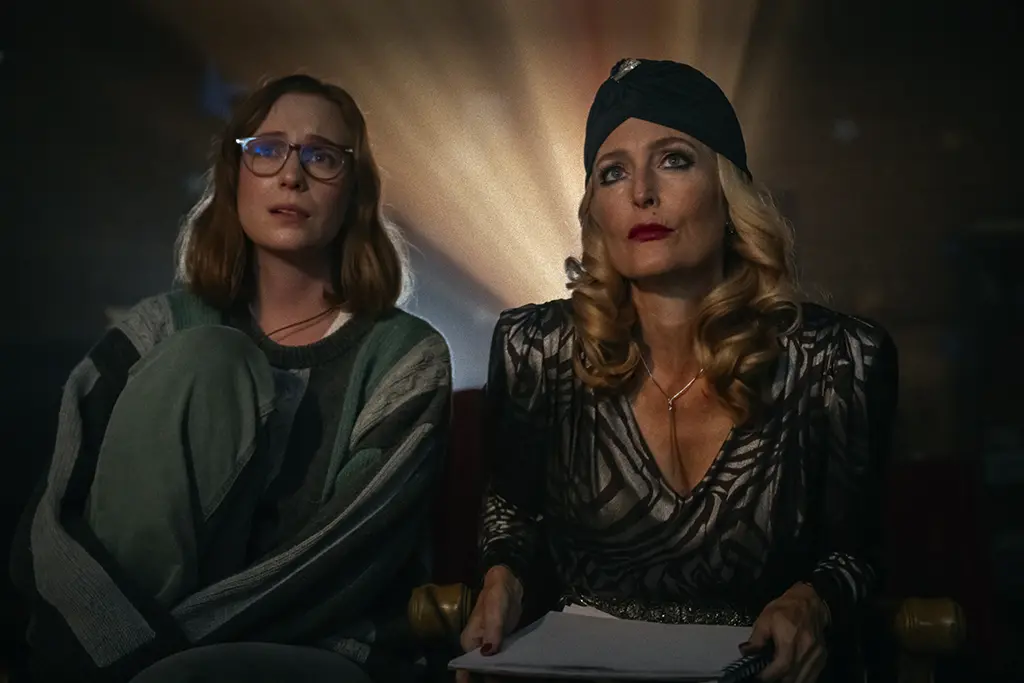
Lastly, we added the Billy layer, which needed to feel more romantic and dramatic, hinting at the private fantasy world she’s created for herself throughout the camp. We sourced vintage theatre seats and installed them in front of the stage. Every surface had dripping wax candles from her many nights alone, getting lost in her favourite films. We dressed in some of her art supplies, just enough to tease the details of her character we’d reveal in subsequent scenes.
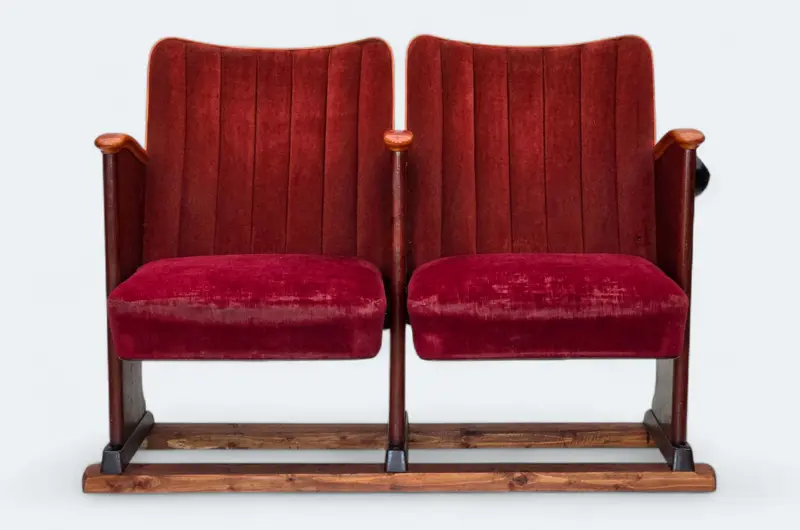
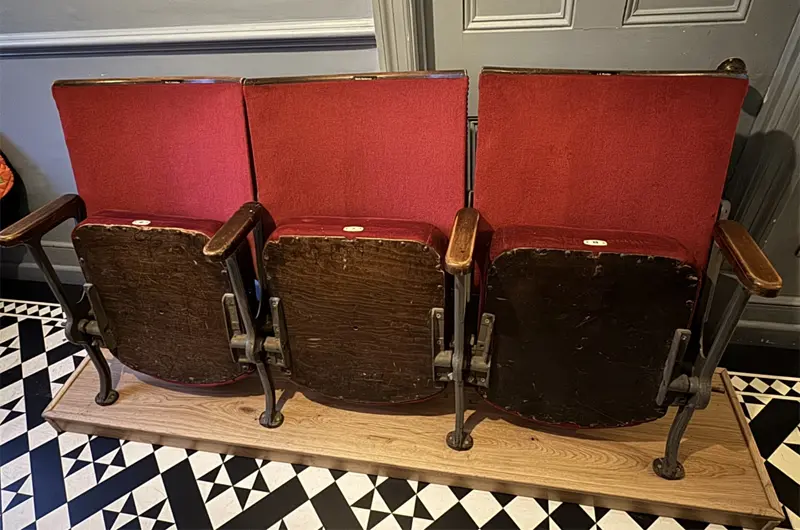
That process of layering one history over another runs throughout the film. The bones of the former summer camp remain visible beneath Billy’s more romantic world, with vintage theatre seats, candle wax, artwork and everyday objects gradually turning a communal space into something intensely personal.
Designing a fictional 1980s slasher
F&F: You create a film within the film that is also a period piece. Can you walk us through designing that and also sourcing period furniture?
BTC/MH: We approached the Miasma franchise similarly to creating the show within the movie for I Saw The TV Glow. The Pink Opaque, the fictional SNICK-like show, wouldn’t just visually mimic 90’s TV shows but instead would look and feel like the memory of watching them for the first time, of escaping into those worlds as a kid.
Our design of Camp Miasma relied on conjuring the audience’s fragmented memories of first viewings of camp movies during childhood (probably at too young an age like Kris in the story). Images and scenes remembered and misremembered and all the emotion they hold for people. We wanted to create a new thing out of those powerful emotions. We wanted to speak the language of the period and genre without necessarily retreading familiar territory.
-
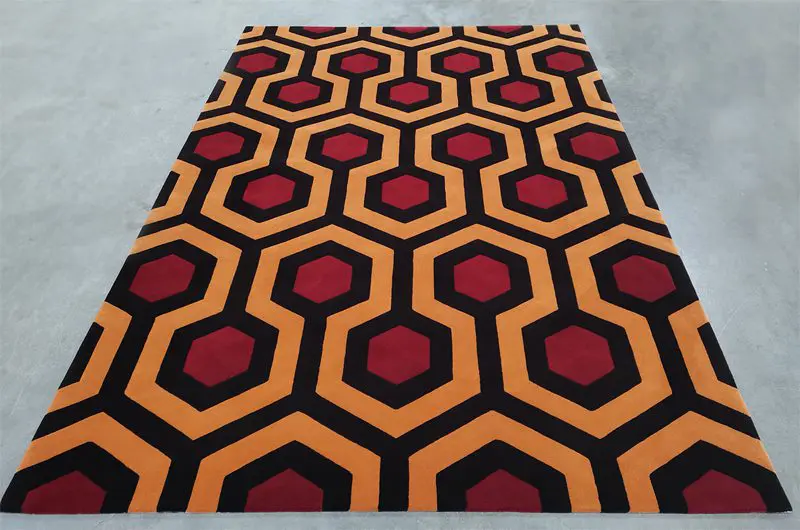
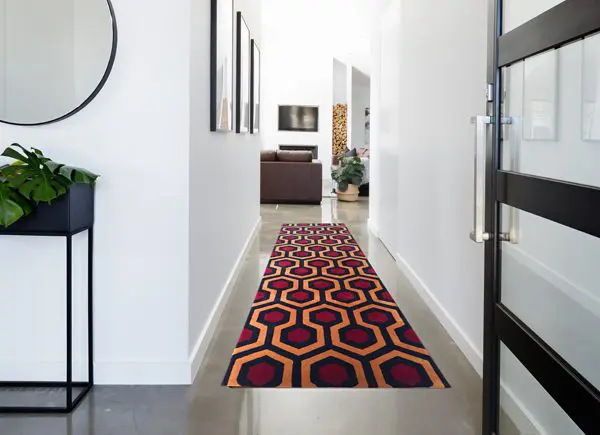
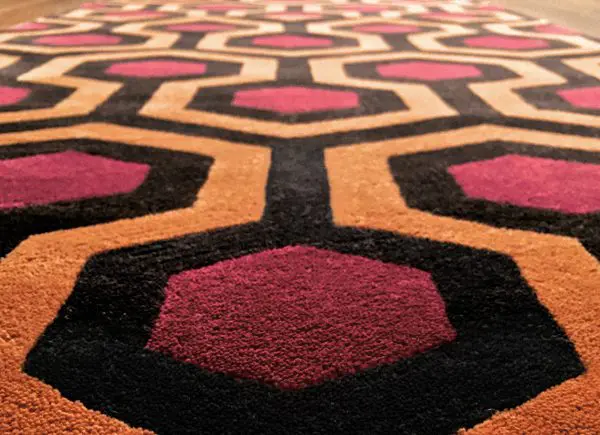
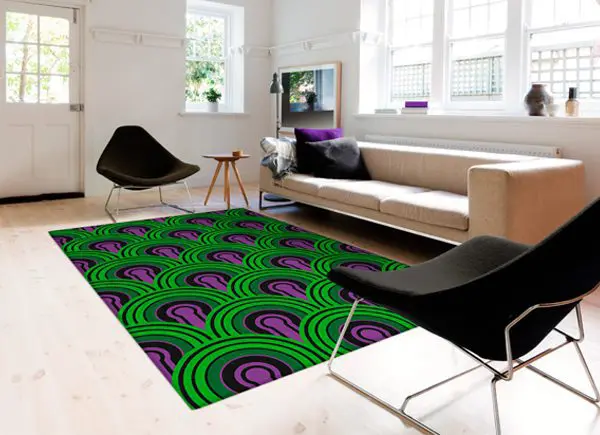
Hicks’ Hexagon officially licensed luxury rugs and runners, designed by David Hicks, as seen in The Shining Overlook Hotel
Designer: David Hicks
Film and Furniture
Directors: Stanley Kubrick, Steven Spielberg, Mike Flanagan
Shop NowOfficially licensed Hicks’ Hexagon rugs and runners as seen in The Shining‘s Overlook Hotel (original design by David Hicks). High quality, custom made, hand tufted 1 ply wool. One of the most iconic carpets in film
Approx Price range: £1,572.00 through £7,342.00 Inc VAT if applicable / $2106
We took our period cues from our favourite slasher movies, wanting to make the spaces a combination of what would have actually been there in real life and what a low budget horror production designer would have put there in 1980. For the lake exterior, a relatively austere set where we see Little Death rise again, we had our construction team build a very specific lifeguard chair and life vest rack we remembered from our research. It’s one of those details that we wanted people to absorb without thinking about it, something familiar that conjures up the memory of watching flesh and fluids before.
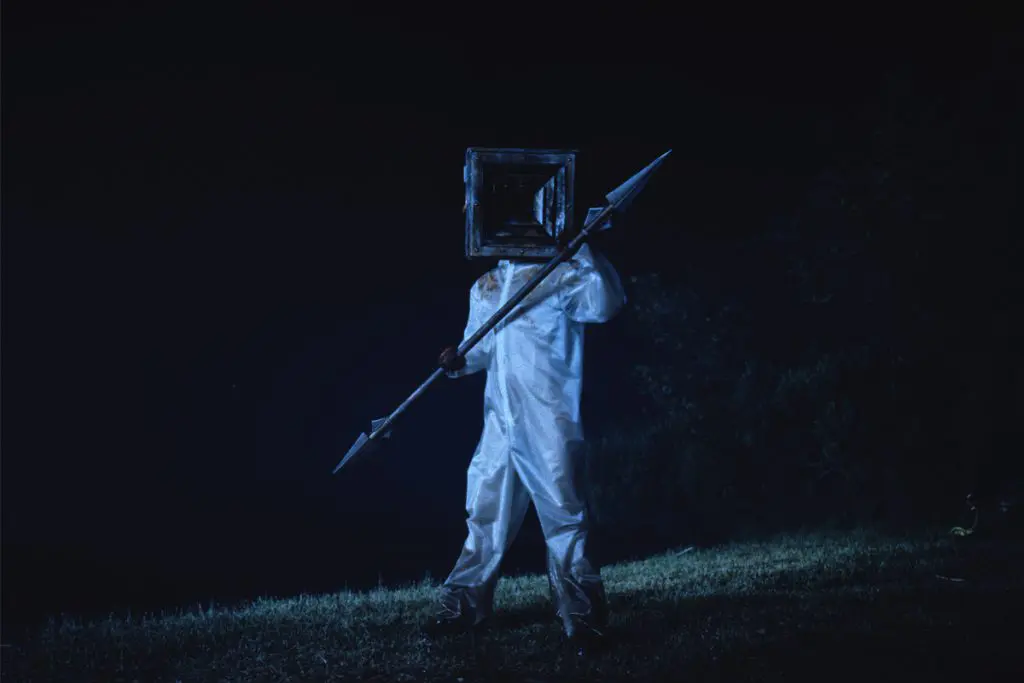
The counselor’s cabin was a tricky set because, whereas the furniture and artwork had to be period and thus probably one-offs, Little Death’s killing spree necessitated SFX unleashing a fire hose of blood around the space every take (which called for multiples for resets). In the end, we were able to find some bigger pieces (the couch, chairs, etc) with basic shapes we liked in quantity at a chain retail store and reupholster them with period-appropriate fabrics. We got our 1980, low-budget horror appropriate furniture, but Little Death could still have their bloodbath unimpeded.
Reviving the lost art of matte glass painting
F&F: Talk to us about bringing back matte glass paintings. What was the process like?
BTC/MH: From our first meetings with Jane, the hand-painted backgrounds were a major part of their vision of the film. We talked about embracing these older, pre-CGI techniques not just for the sake of making beautiful forest landscapes, but to bring the audience into the emotional landscape of the characters. They’re intentionally dreamlike visuals that act as portals to a fantasy world of play Billy has constructed, almost like Kris is stepping into her artwork. We start with a distant cityscape outside the window of Kris’ hotel room, almost calling to her, and from there she gets closer and more absorbed with each landscape.
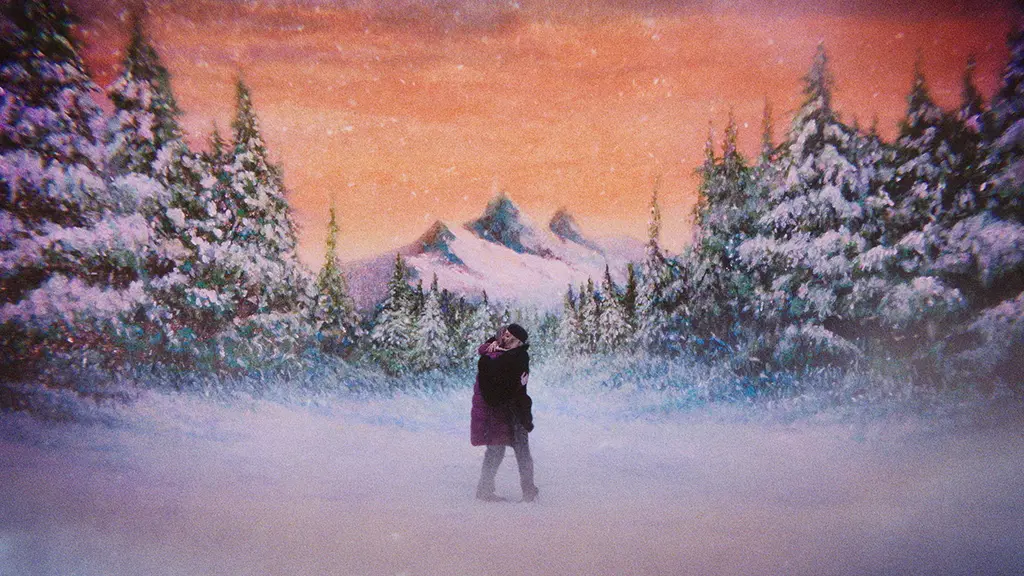
Physically creating them took a lot of research and discovery. We couldn’t find another Production Designer who had made a similar matte anytime this century, especially on the indie scale we were operating within. For films in the pre-digital world, mattes tended to have a separate filming unit devoted just to those individual effect shots. They also typically relied on the controlled environment of a studio for at least a portion of the process. We were doing it without any of those resources, and in a remote location, all while we were shooting the rest of the movie.
A book called The Invisible Art by Scott McCloud and a Tumblr-style blog called Matte Shot, both obviously labours of love from their authors, helped us get more literate in the techniques. We picked the five spots in the movie when we wanted to use some version of a painted background and broke each one down. We settled on doing four of them as hand-painted pieces we would composite into the background afterward, shooting Billy and Kris against a massive blue screen and then creating a painting to match the perspective for post to carefully drop in.
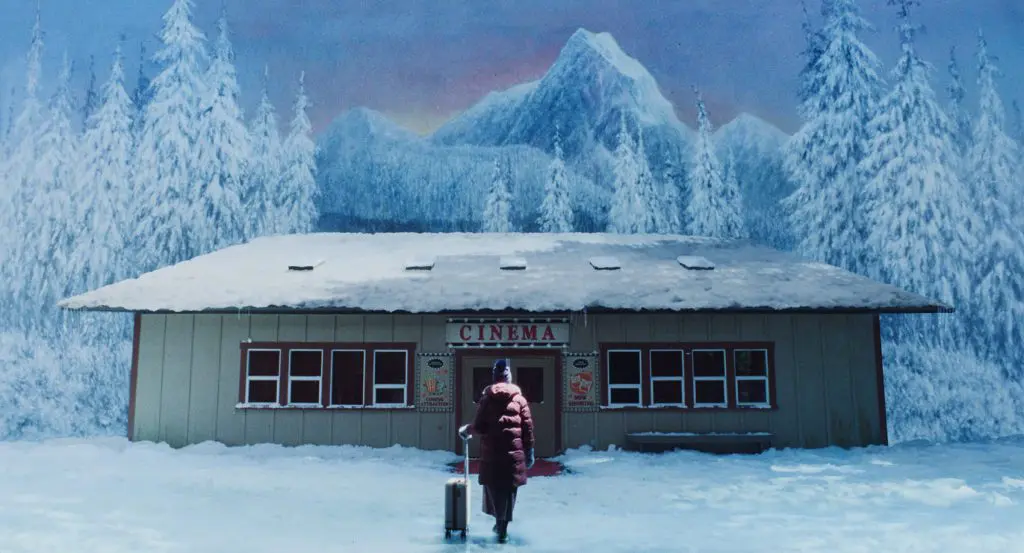
The trick, of course, is that it all has to be lined up down to the inch for the effect to work. If the glass or the camera or the painting or the weather/natural light is off at all, the image doesn’t make sense, and you end up not getting the shot. And Eric the DP and everyone else would be off shooting the rest of the movie while we were making the glass matte, so we wouldn’t know if it worked until the moment we were on set attempting to shoot it.
We lined up the frame, created the concept art for Jane to approve, and then taped off the parts of the piece of glass we didn’t want our artist to paint. We literally had to tie a string around trees and stakes in the ground to have a backup system to mark exactly where the camera should go weeks later. Our artist, Erkin Aycan, had never made a glass matte either, but he was a fine art painter and our bravest scenic, so he boldly volunteered. At that point, we were already out at the remote camp location, so we relocated his studio to a hotel room, flipping the bed up against the wall and locking him in for a week with the concept art we’d created and a room service menu.
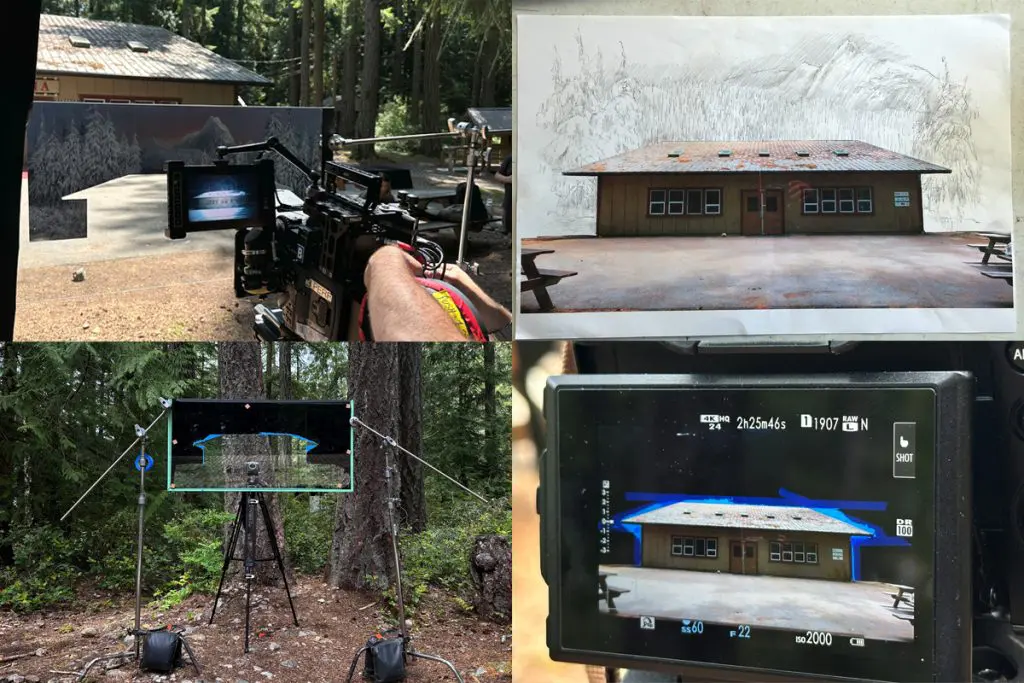
His painting was beautiful, but we still didn’t know if it would work until we got to set with the shooting crew and lined it up. We were holding our breath, but it went off perfectly. When Hannah stepped into the frame, it looked like it was supposed to, an impossible landscape, a visualization of pure emotion.
The glass matte painting helped create a whole world for everyone on set, a bubble we could all step into together. It’s a magic trick on screen, but it was also meaningful to be there in person and see it come together as a group at an isolated forest location. We think Jane felt that and shot some footage of the effect actually being set up, which ended up being incorporated into the final cut.
The furniture and vintage finds that defined Camp Miasma
If matte painting creates the film’s fantasy landscapes, it’s the furniture and objects that make Billy’s world feel lived in. Remarkably, around 90 per cent of the set decoration was sourced locally on Vancouver Island.
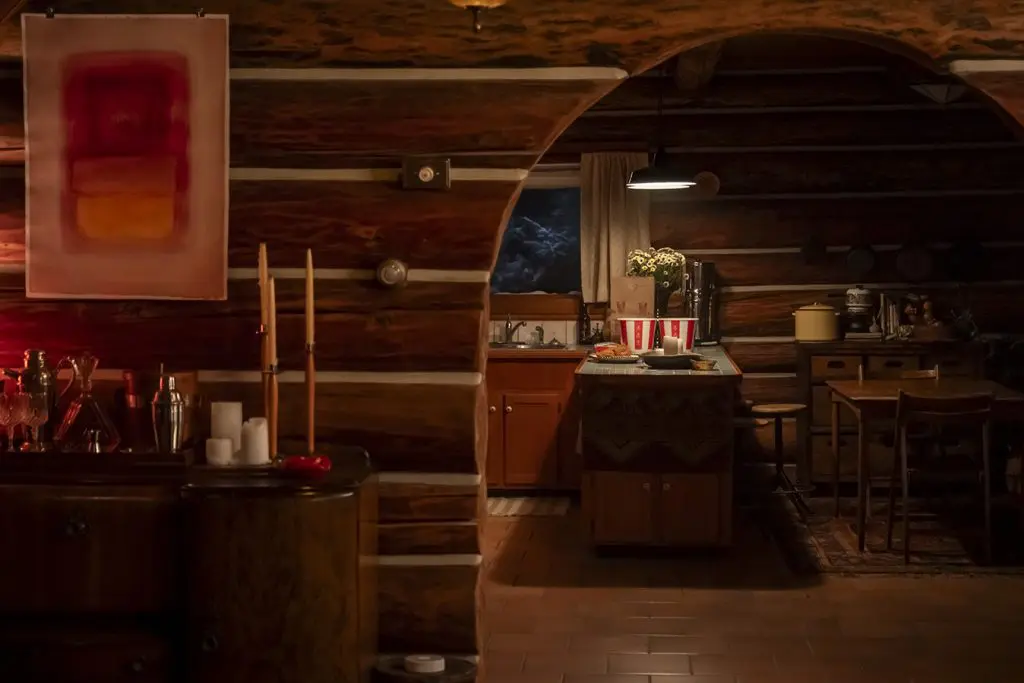
F&F: All the interiors feel so layered in the film. Are there any furniture or set decor elements that you particularly loved – how and where did you source them?
BTC/MH: Thank you! About ninety percent of the decoration actually came from Vancouver Island; we were sourcing everything locally. Often by necessity, since the logistics of getting trucks over on the ferry from the mainland weren’t the easiest to maneuver.
Our Set Decorator, Hana Cook, found some one-of-a-kind pieces and really understood how lived-in and fully realised the sets needed to be. We design the sets for the camera, of course, but also for the people in the room when we’re shooting. The details are incredibly important, regardless of whether the camera sees them up close, or how subtle they might be. Hana had a strong handle on the creative vision from the jump and worked tirelessly.
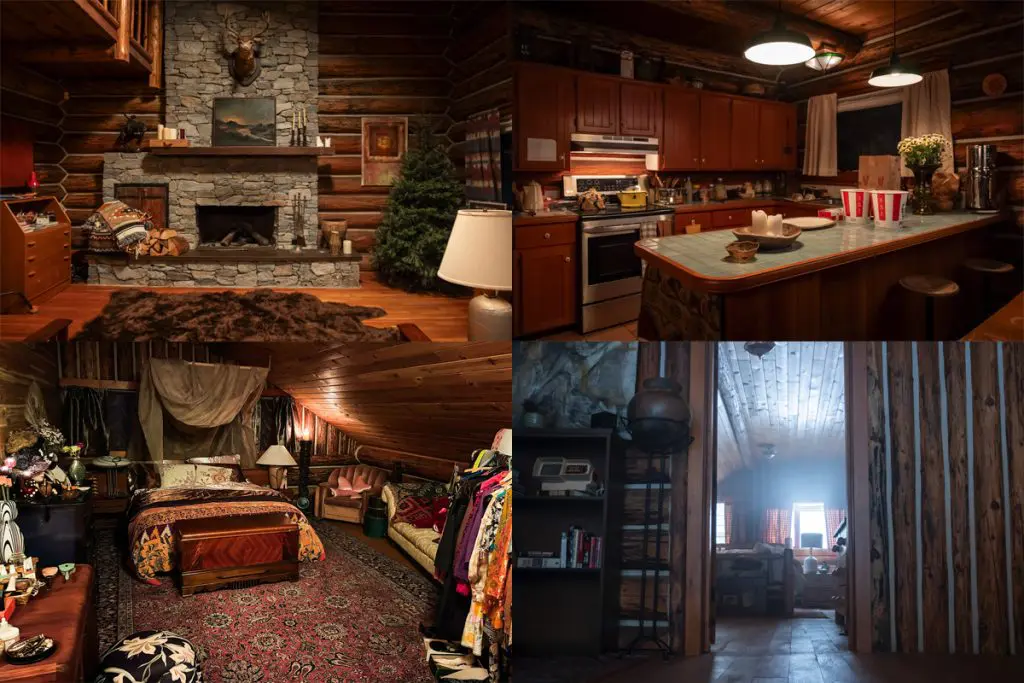
One of our favourite pieces is Billy’s couch, which was a major decision. We knew there would be a shot moving up and over it to reveal Billy and Kris on a rug in front of the fireplace, so we needed something iconic that could live up to our reference for the camera move, Videodrome (David Cronenberg, 1983). We had dozens we were looking at until we found a beautiful, weathered orange MCM leather piece from Scott Landon Antiques in Vancouver. It was exactly what we wanted for the character: rugged, worldly, and seductive (with an alluring history). It was worth the ferry headache to get it over.
Found Studio in Victoria was amazing. When we went to their very curated showroom, we wanted to grab everything for Billy. We ended up featuring the foreboding landscape paintings of a local artist they work with, some beautiful leather chairs to pair with the couch, and the refinished dining table and chair set that really anchored the room (along with many other details). Morgan, there was a great resource, and we still check their Insta constantly since they ship worldwide.
We also snagged some great layers from Alleykatz, a second-hand store on the island. It’s basically a house by the side of the road packed with vintage smalls and furniture. The day we went it was closed, but the owners (a married couple) saw us prowling around looking in the windows and opened up for us. They had the coolest things, like a wooden plinko tabletop game someone had made in the 70’s. Instead of dropping a ball or a chip down through the maze of wooden pegs, though, it was built for M&M’s, which was perfect for a candy fiend like Billy. For Billy’s bedroom, we used a vintage dresser they had refinished and painted an original floral design on. They were a lifesaver, and we became good friends, sending them occasional SOS texts for hard-to-find items.
Red’s Emporium and Lulu’s Vintage on the island also had great finds.
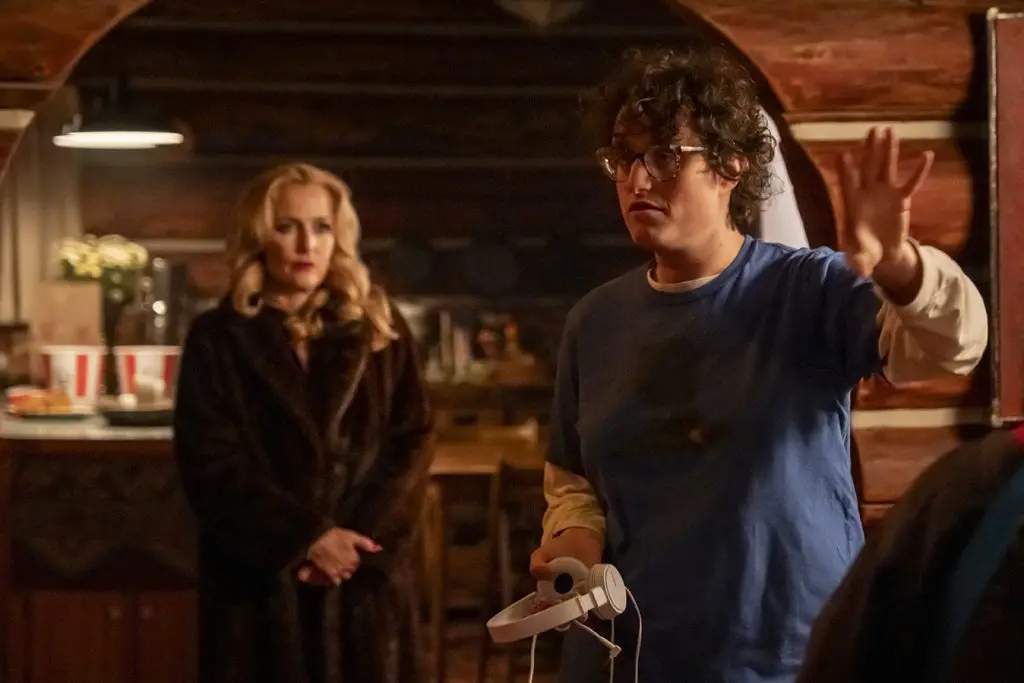
Taken together, those locally found pieces, handmade artworks and deliberately old-school cinematic techniques give Camp Miasma its peculiar sense of accumulated history. Billy’s world feels as though it has been assembled over decades, which, of course, is exactly what we’re meant to believe.
Take a good look at the Teenage Sex and Death at Camp Miasma production design yourself – the film is in cinemas now.
Sponsored post
This feature is FREE to Classic members.
Join our newsletter community to receive Film and Furniture inspiration direct to your inbox and we’ll UPGRADE you to Classic Membership (which includes access to our exciting giveaway draws) for FREE.


 Facebook
 Twitter
 Instagram
 Pinterest
 RSS
RSS