


A Home That Remembers: The Design of Sentimental Value
This feature comes to you in partnership with Holloways of Ludlow
It is often said that a house can become “a character” in a film. In Sentimental Value, that has never been truer.
Nominated for nine Academy Awards and eight BAFTAs, Sentimental Value is one of the most talked-about films of the season. Directed by Joachim Trier, the Norwegian drama – spoken in Norwegian, Swedish and English – follows estranged sisters Nora (Renate Reinsve) and Agnes (Inga Ibsdotter Lilleaas) as they reunite in their childhood home after the death of their mother. Their father, Gustav (Stellan Skarsgård), a once-celebrated film director, attempts to reconnect by casting Nora in a new film inspired by their family history. What unfolds is a layered meditation on generational trauma, missed opportunities, artistic ambition and the fragile mechanics of reconciliation.
But beneath the performances and the emotional reckoning lies something even more unusual. This is a film about a house.
The Norwegian home becomes the thread running through every generation. Walls are painted over, furniture and lighting are replaced, yet traces linger. The house evolves with the family: sometimes hopeful, sometimes bruised, but never neutral.
As production designer Jørgen Stangebye Larsen explains, “The house is an archive of memory or like a container of feelings and emotions… it connects all the characters in the film, but also they have a relationship to the house.”
Join us as we dissect the interiors with designer Larsen: Read on below, watch the full video interview coming to our YouTube channel soon, or listen to The Film and Furniture Podcast on your favourite podcast platform for even deeper insight into how this remarkable house was brought to life.
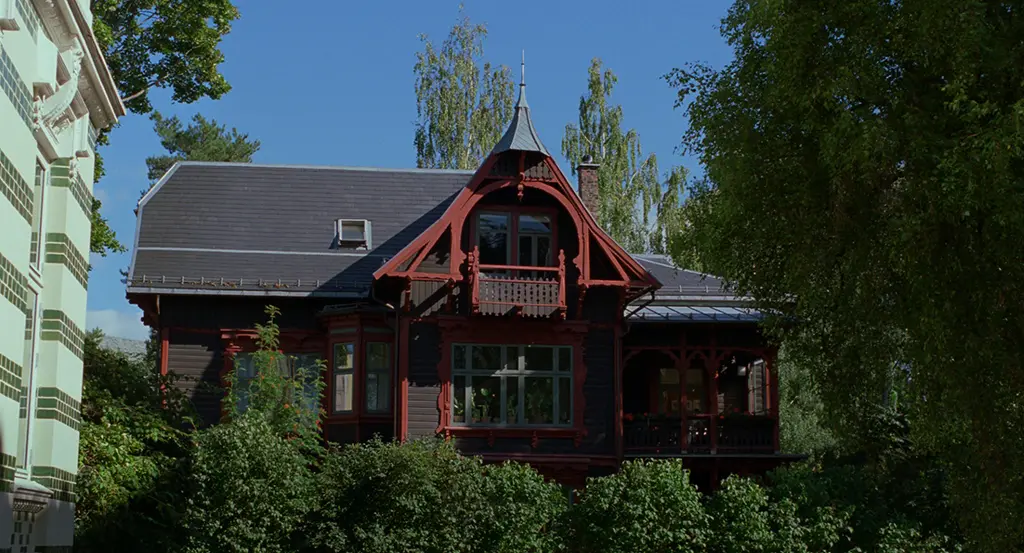
The property is real: a gabled timber house in Oslo, painted dark brown with deep red detailing. It belongs to the Norwegian Dragestil, or “dragon style”, tradition – architecture prominent between 1880 and 1910, influenced by Viking ship ornament and steep medieval rooflines. It feels storied before we even step inside.
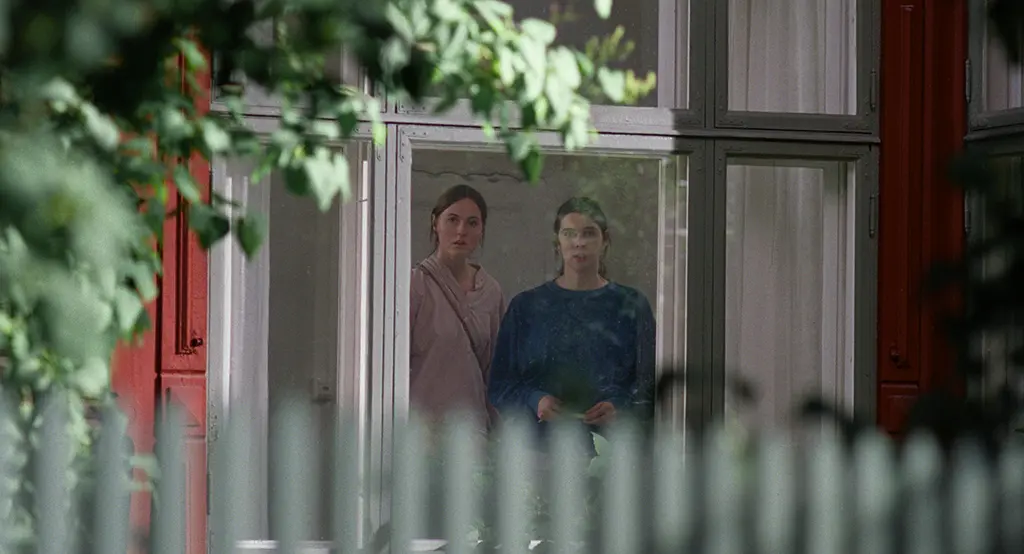
Larsen already knew the house before production began. He and Trier had filmed there years earlier, and it had stayed with them. The house was part of Sentimental Value from the outset, before the script was fully formed. Its proportions, its staircases, and its sequence of rooms shaped the storytelling. And what stories it holds! As Larsen recalls, “We had a concept that the house is kind of observing the people coming and going… the windows became like the eyes of the house.”
A House Through Generations
The narrative moves through an arc of ownership: Gustav’s great-grandfather died in the same bedroom in which his grandmother was born. His mother grew up here in the 1930s, was active in the resistance, and eventually took her own life here. His aunt Edith then lived in the house through the 1950s and 60s, and into the 80s. In the 1990s Gustav himself, his wife and daughters made it their family home. Now, in the present, after their mother’s death, the sisters clear it out. Finally, Gustav sets his last film within its walls.
We watch history sediment through furniture and décor.
“It was very important for me to go very authentic,” Larsen explains. “I didn’t want to romanticise or make a pastiche of these time periods. I wanted it to just feel natural.”
The Early Years
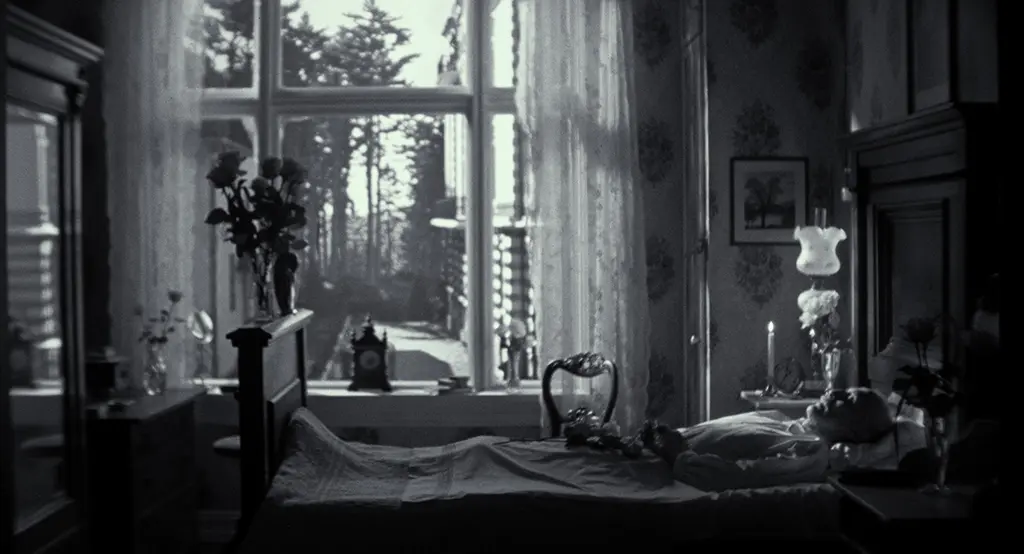
A series of flashbacks begin in the early twentieth century. In the bedroom where the great-grandfather dies, dark wood furniture dominates. Solid, weighty pieces that speak of permanence and lineage,
By the 1930s, gramophones, dense timber sideboards and a wallpaper in dark sage with vertical white and pink floral motifs have appeared. Heavy curtains frame the windows. The family appears comfortably well-to-do and intellectually inclined. The atmosphere is formal, but cultured.
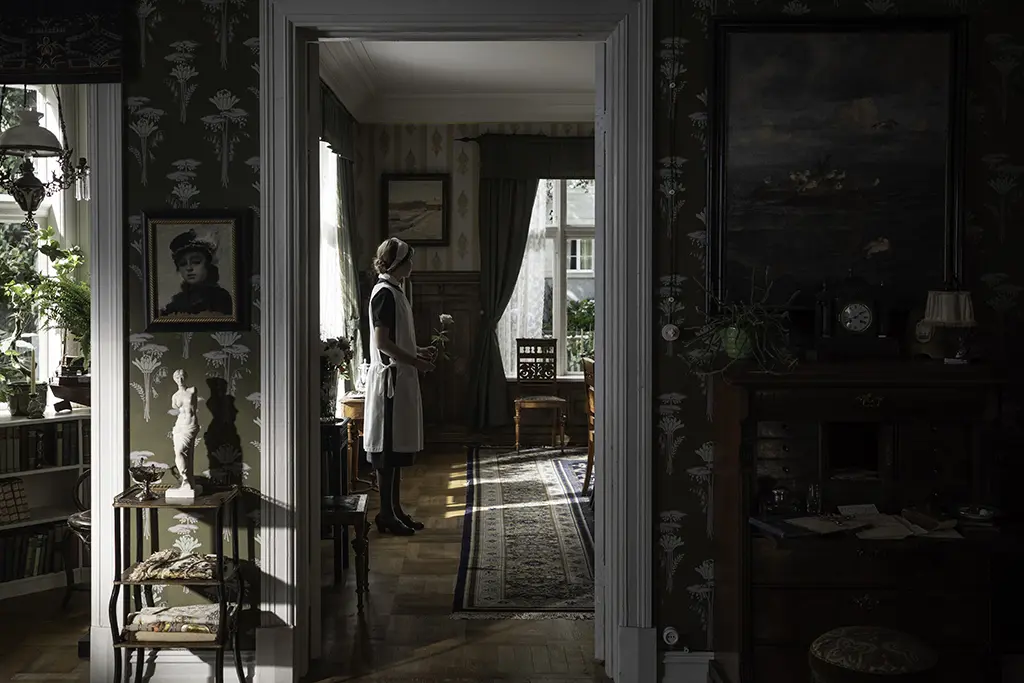
To achieve this, Larsen went deep into archival research. “I found this family business that were finding wallpapers behind different layers of paper and recreating the patterns manually — producing them the old way.”
The 1940s library deepens that tone — books, layered surfaces, intellectual gravity. This is a house of ideas.
The 1950s and 1960s: Contained Grief
After Gustav’s mother takes her own life, the house passes to her sister, Gustav’s Aunt Edith, and in the 1950s and early 60s the interiors shift. New decorative wallpapers appear on the walls and paler woods replace earlier heaviness. A radiogram cabinet signals post-war domestic modernity and aspiration. Edith holds parties; friends fill the house.“I felt it was this kind of time of liberation… carrying something very heavy, but living life and going on,” Larsen says.
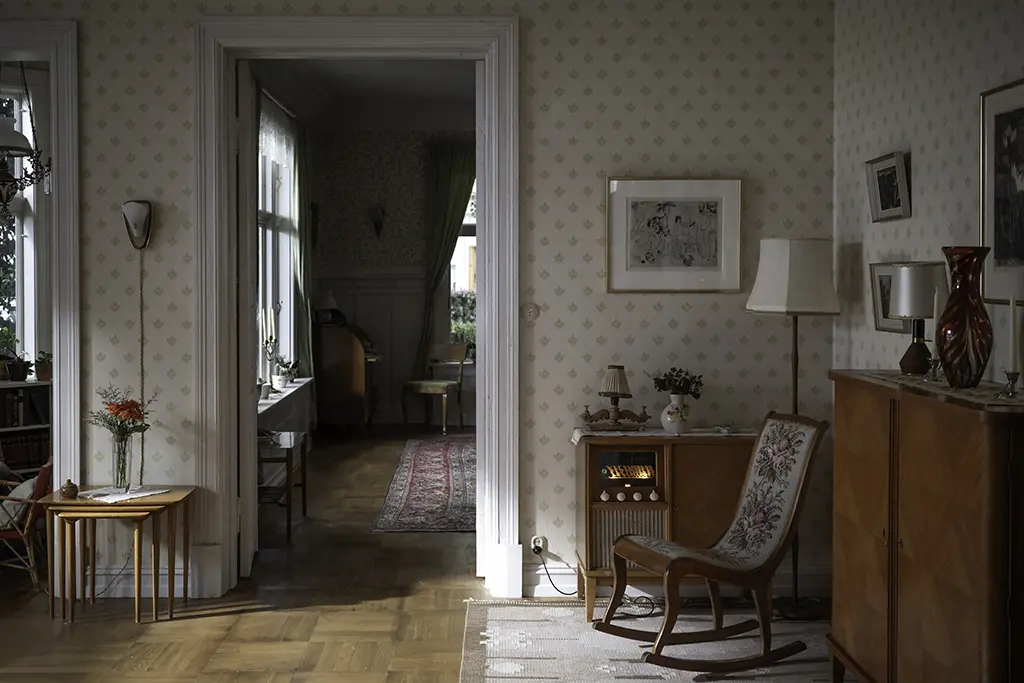
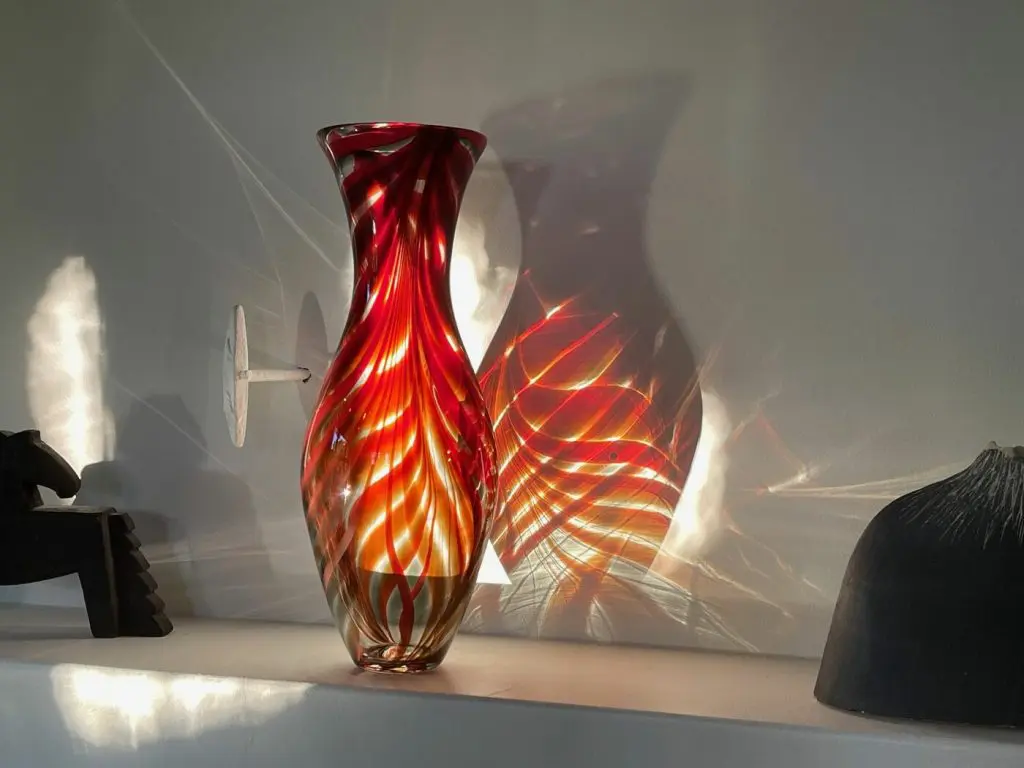
And on a cabinet sits a tall red glass vase with a swirling design. We barely register it at first. But it will return.
This is a house holding grief quietly. Not dramatic. Not loud. Just contained.
Late 1980s into the 1990s: Renovation as Rewriting
When Gustav returns in 1986 after years in Sweden, he strips the house back. Wallpaper is painted over with clean white. Wood panelling is ripped out.
Before this we see the 1980s living room with an orange sofa, colourful geometric curtains, expressive lamps and bold artwork. It is vibrant, slightly chaotic, energetic but unsettled.
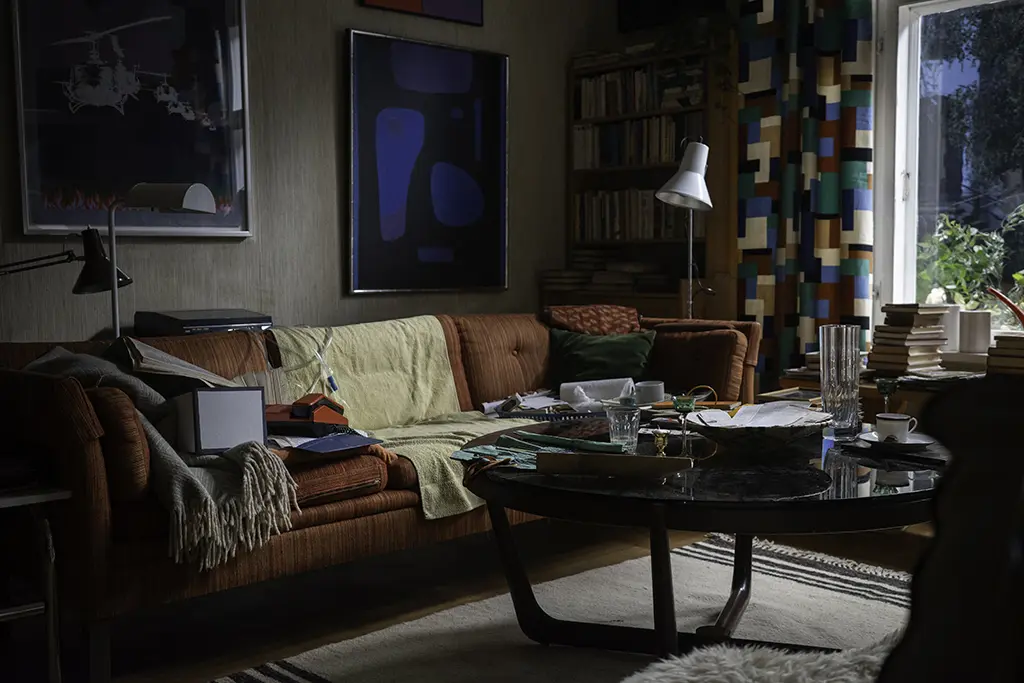
Gustav is trying to start again. But houses remember.
By the 1990s, the mood changes. The children Nora and Agnes are young. The interiors feel relaxed and confident — shaped by the belief this is a home that will last forever.
Here, Larsen and set decorator Catrine Gormsen mix IKEA pieces from the period with Scandinavian modern classics and antiques. Nothing is overly staged. Nothing screams “design icon”.
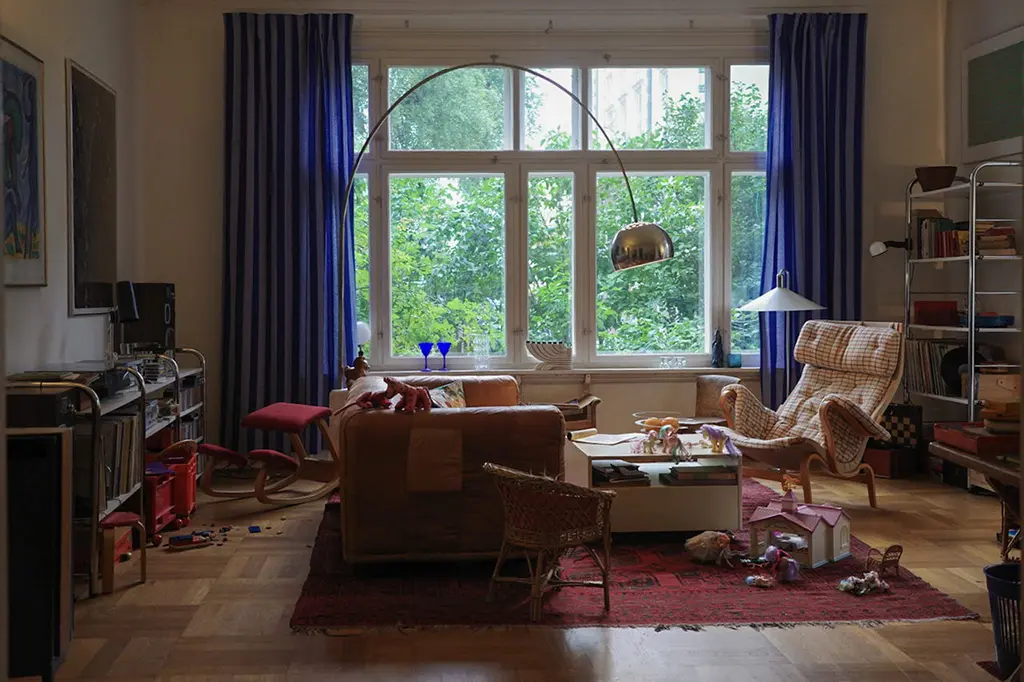
The Pernilla chair by Bruno Mathsson becomes Gustav’s armchair — vintage, slightly worn, upholstered in checked textile. It is where the sisters climb as children. Where finger-puppet theatre unfolds. It feels inherited, perhaps brought from Sweden. “When I found it online for auction… I remembered that fabric from our summer house. I got a bit nostalgic, I have to admit” Larsen tells us.
The iconic IKEA Klippan sofa still in production today is covered with a vintage leather patchwork cover. It anchors the room beneath the sculptural Arco floor lamp. “That Klippan sofa with the leather patchwork cover — I remembered it very much from that time. We were lucky enough to find that cover,” Larsen recalls.
Seating is floated in the centre of the space rather than pushed against the wall, allowing vintage IKEA shelving and a proper 1990s sound system to sit behind.
A vintage Bang & Olufsen television rests on a wheeled nightstand — practical, movable, slightly improvised.
Upstairs, an iron stove connects rooms acoustically, allowing Nora to overhear therapy sessions her Mother holds below: the house hears things.
These details ground us precisely in time, but more importantly, they reveal character: culturally engaged, playful, not rigid. A family who love film, art and music, and who do not mind toys on the floor or books half-read.
It is during this period, however, that the fault lines begin to show. Gustav and his wife argue. The atmosphere shifts. Eventually, he leaves.
The Present: White Space and Emotional Fault Lines
In the present day, the house is largely white. Minimal. But emptiness is deceptive.
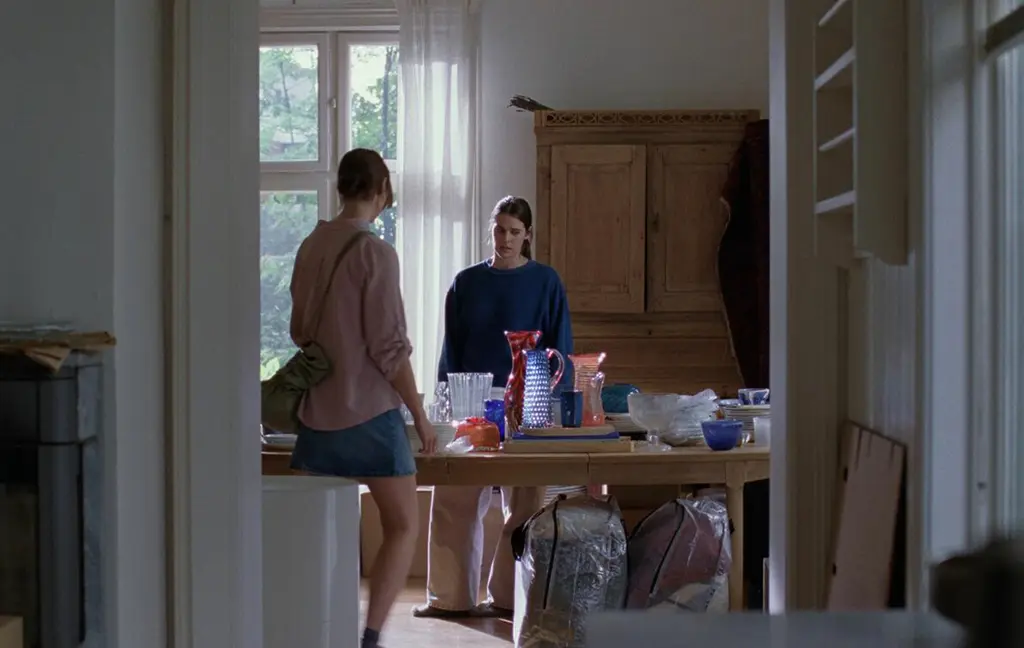
After their mother dies, the sisters start the clear-out, confronting objects. The red-orange Murano glass vase – created for the set by a glass blower friend of set decorator Gormsen – returns. The vase is now central to a moment that balances deep-rooted emotion with quiet comedy.
“It had to be a vase that could have been in the house in the 40s or 50s,” Larsen explains. “But it also had to be an action prop… so we made three of them. We took the best we liked from the references and made it in the right shape… they became very beautiful.” It becomes the embodiment of the film’s title. What do we keep? And what do we keep simply to prevent someone else having it?
Even an IKEA stool shown to the ambitious American actress Rachel Kemp (Elle Fanning), who agrees to star in Gustav’s new film, becomes the butt of a joke.
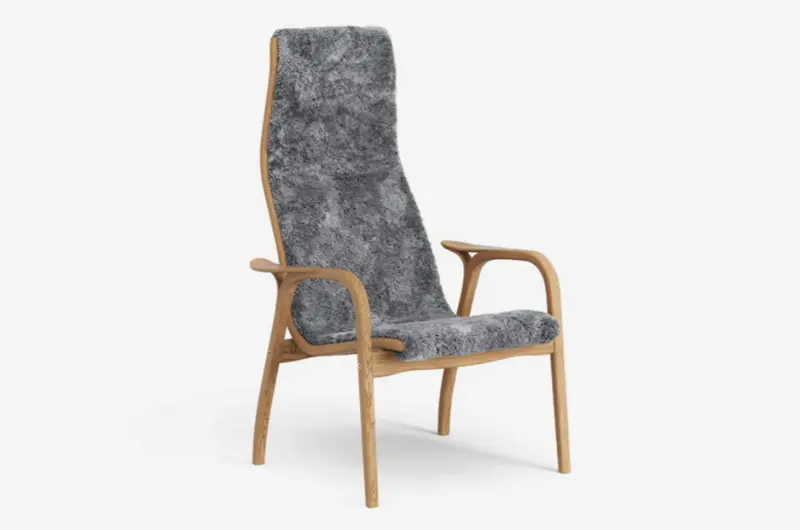
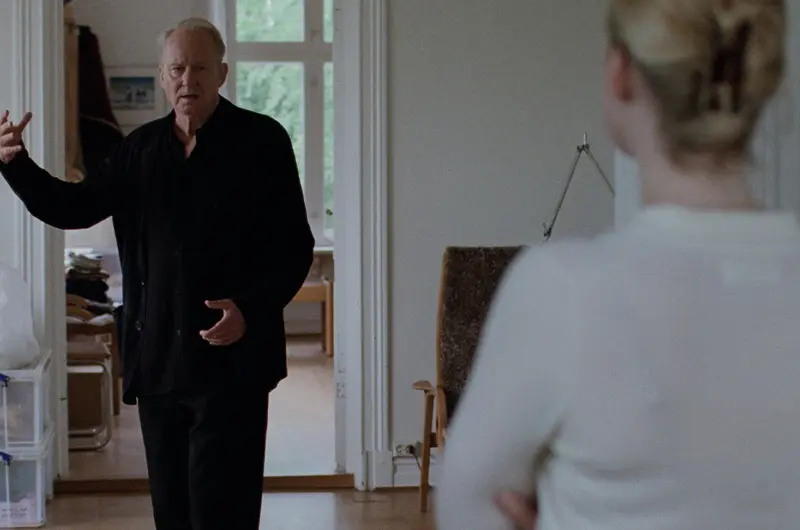
As Gustav plans his new, and possibly last, movie in the house, we glimpse a Swedese Lamino Easy Chair with grey sheepskin – a Film and Furniture favourite.
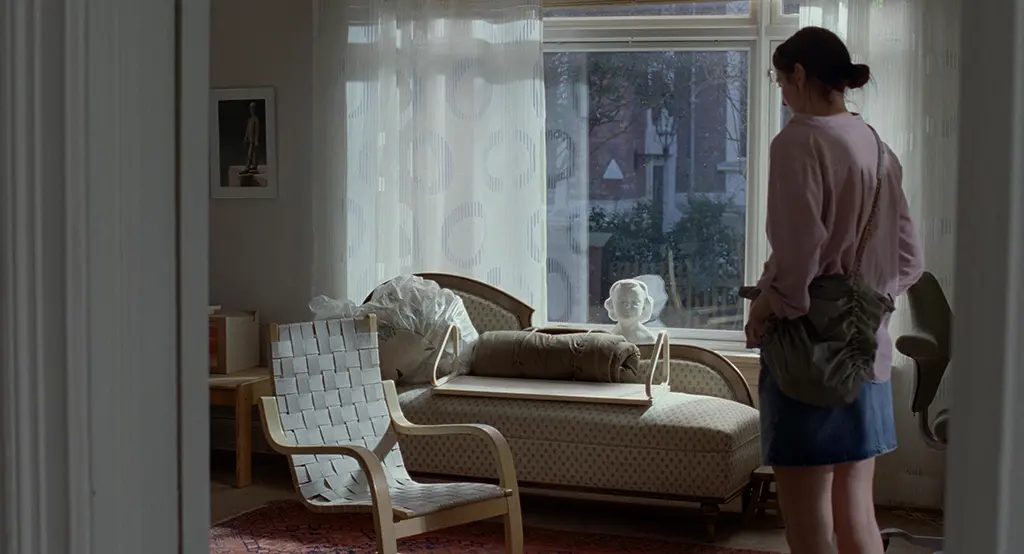
In the mother’s former therapy office, a vintage chair by Alvar Aalto from Artek anchors the room. On the wall, a black-and-white textile artwork of dots and lines suggests connections across generations, almost like an abstract family tree.
In the dining room, a lime-washed cupboard stands beside a Piet Hein dining table with Series 7 chairs by Arne Jacobsen and a Cesca chair with arms. Modernist clarity sits comfortably alongside older vernacular craft — exactly the kind of layered mix that defines the house.
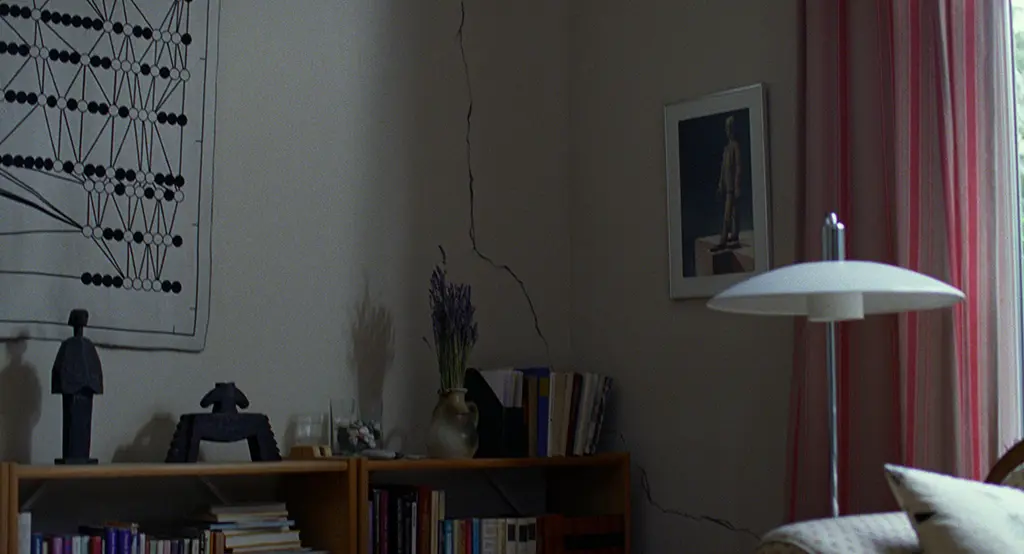
And then there is the crack in the wall. Almost incidental. But structural. A fissure you can plaster over, but never entirely erase. Larsen calls it “the main crack in the film,” something that becomes symbolic of “marks from trauma — or good things, or bad things.”
The Final Renovation: Beautiful — and Anonymous?
In the final scenes, we see the house fully renovated in a predominantly grey and white colour scheme: new kitchen, herringbone floors, new furniture and immaculate finishes. It is undeniably beautiful. But it is also generic.
“Under that, it’s kind of sealed — the history and all the traces of life,” Larsen reflects. “It just becomes a new home.”
The sediment of memory has been smoothed away.
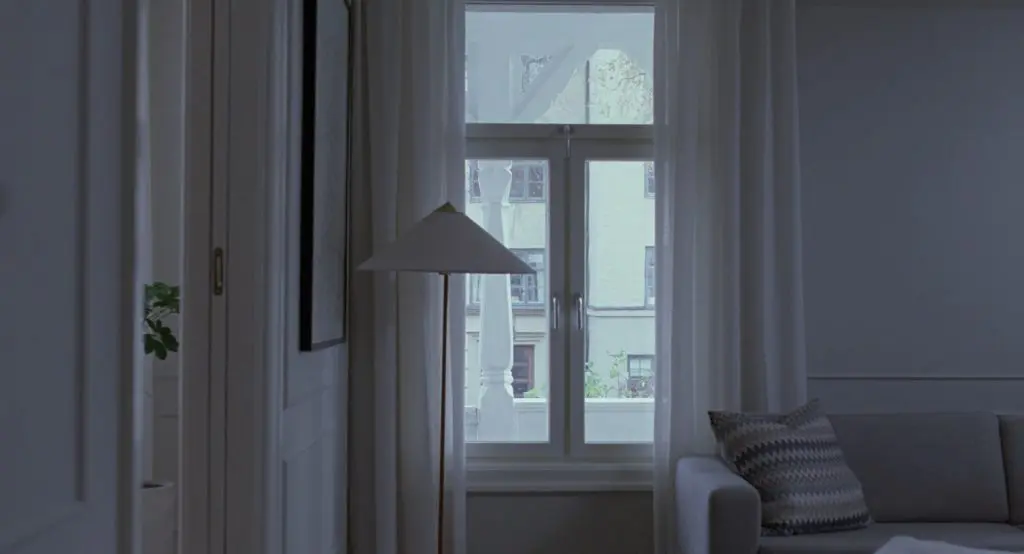
There are still moments of personality. A Gubi 9602 floor lamp — the 1935 design sometimes known as the Chinese Hat, with its elegant triangular shade and rattan-wrapped stem — introduces a gentle warmth. Its soft ambient light feels almost human against the otherwise controlled palette.
Sentimental Value suggests that interiors are biography. Wallpaper grounds us in time. Chairs reveal inheritance. A radiogram speaks of aspiration. A 1990s sofa signals optimism. A red vase becomes the axis of sisterly tension.
A house absorbs what happens within it. And it never entirely forgets.
As Larsen recalls living in his grandmother’s apartment: “You just know that you live in a space that has a lot of meaning back in time… it almost made me feel less lonely somehow.”
Building Sentimental Value at Home
Sentimental Value is a reminder that real homes are built slowly, through objects as much as through people. Furniture is never simply aesthetic. It absorbs life. It becomes the architecture of a family.
That philosophy sits as the heart of Scandinavian design. Not minimalism for minimalism’s sake alone, but for longevity, craftsmanship and quiet integrity. Pieces chosen with care and lived with for decades.
Vases: Character in Glass
The swirling red glass vase in the film feels inherited — travelled, slightly dramatic, and deeply personal. It holds memory, both fragile and enduring. A perfect metaphor for “sentimental value”.
Scandinavian interiors have long embraced glass and ceramics as future heirlooms, objects that catch northern light and grow richer over time.
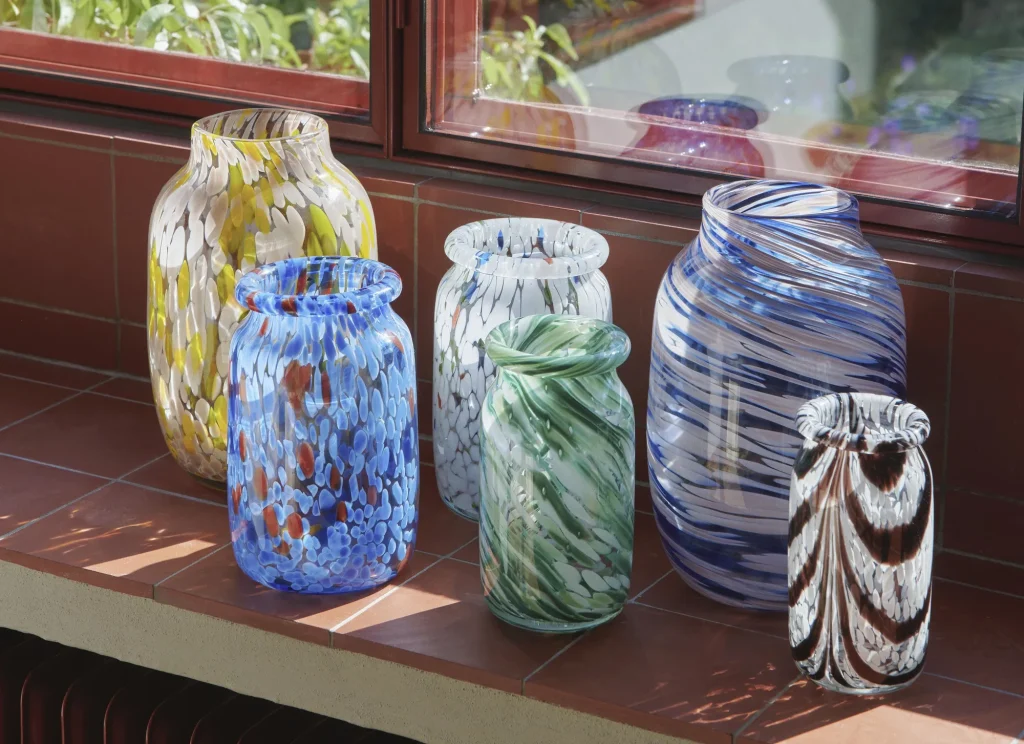
The Splash Vase series by HAY is handmade using layers of coloured glass that melt into distinctive swirls. No two are identical. It has presence now, but its craftsmanship ensures it will still feel relevant years from today.
Equally expressive is the Jessica Hans Vase Glossy Cow, a collaboration between HAY and ceramic artist Jessica Hans. Built and decorated using materials in their natural state, each stoneware piece has an intentionally uneven form and hand-painted surface. Organic, abstract and unapologetically individual, it feels closer to sculpture than ornament.
These are not trend-driven accessories. They are character pieces – the kind the quietly become part of a family story.
Enduring Scandinavian Icons
The film’s 1990s interiors balance democratic IKEA with enduring design classics — a mix that feels cultured without being performative.
That same balance can be found in the collections at Holloways of Ludlow.
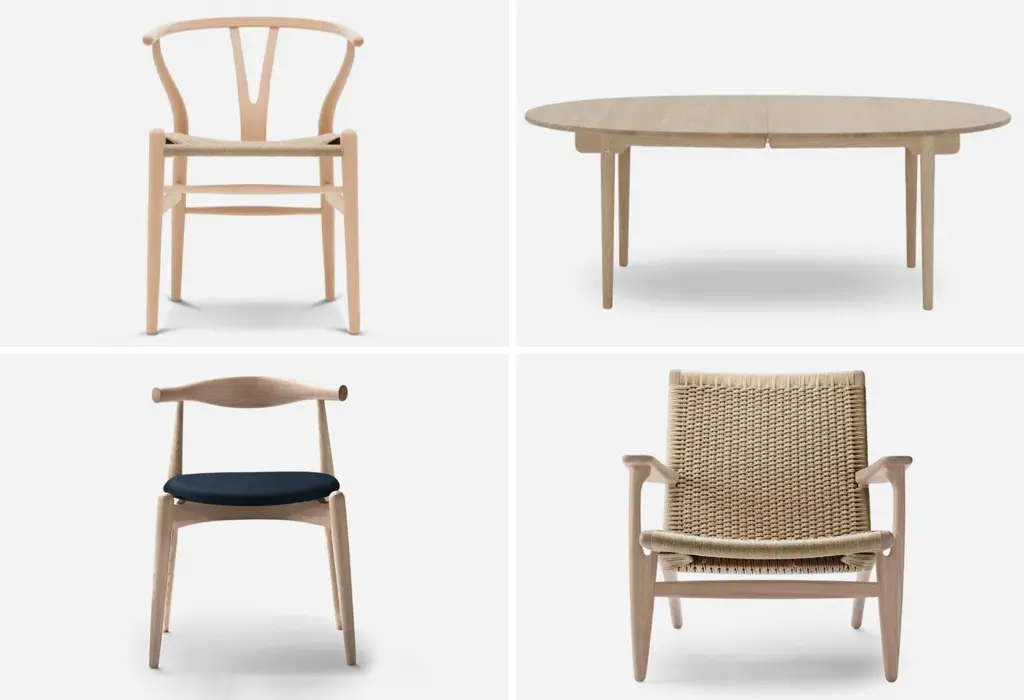
Danish company Carl Hansen & Søn, founded in 1908, continues its long collaboration with Hans J. Wegner through pieces such as the Wishbone Chair — sculptural yet restrained, designed to be used every day for generations. The CH25 Lounge Chair, CH20 Elbow Chair and CH338 Extendable Dining Table all share that same commitment to proportion and craftsmanship.
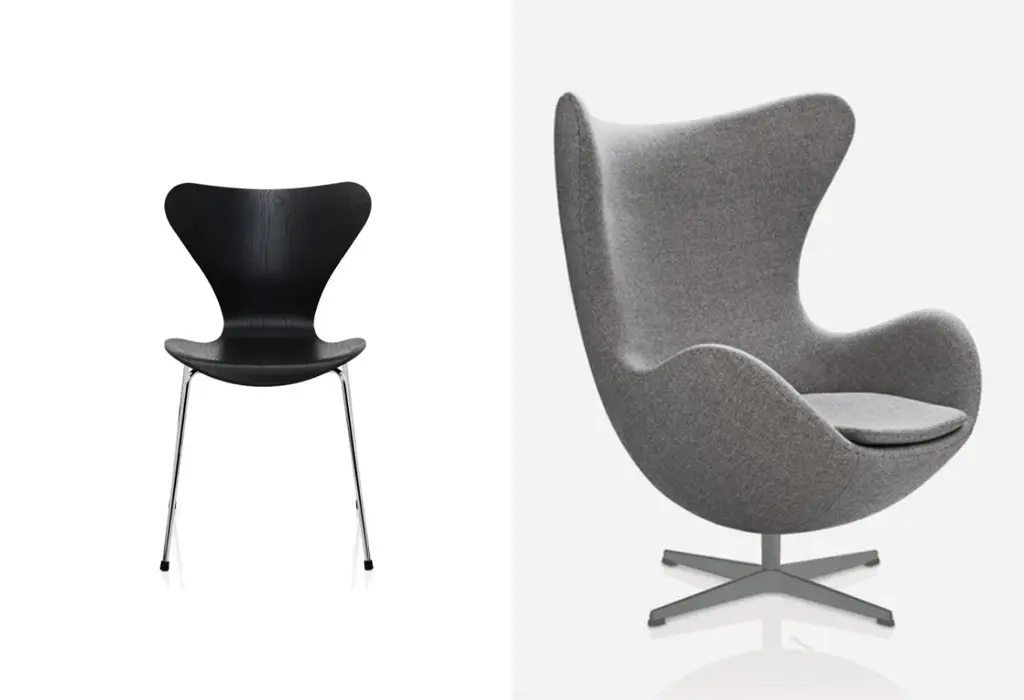
Fritz Hansen’s Arne Jacobsen Series 7 chair — seen around the Borg family dining table — remains one of the most recognisable silhouettes in modern furniture history, while the Egg Chair continues to be a statement piece.
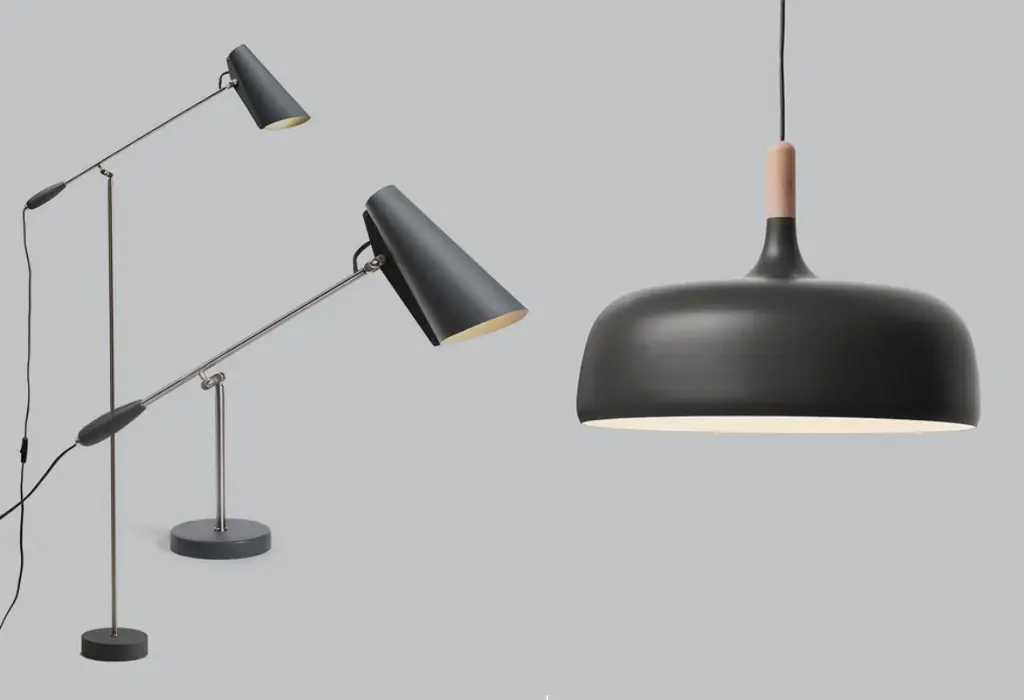
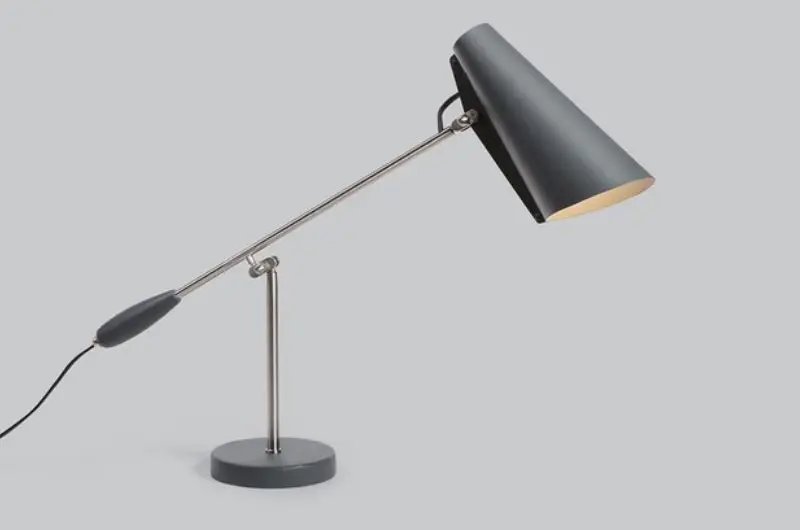
From Norway, the furniture and lighting brand Northern brings a contemporary interpretation of Scandinavian simplicity. Their Birdy table lamp and Birdy floor lamp, part of Birger Dahl’s 1952 modernist series, offers refined, adjustable light that feels both archival and current, and their Acorn Pendant Lights are exactly the kind of pieces that would sit comfortably in the Borg home across decades.
And last but by no means least, the Swedese Lamino Easy Chair — glimpsed during Gustav’s film rehearsals in the house with Rachel — offers that same soft modern warmth.
The most compelling interiors are not assembled overnight. They evolve. They witness. They carry marks — visible and invisible – to become part of YOUR family story.
Sentimental Value is available now on MUBI, and can be streamed or purchased via Prime Video, Apple TV and other digital retailers.
And like the house at its centre, it lingers long after you leave.
This feature is FREE to Classic members.
Join our newsletter community to receive Film and Furniture inspiration direct to your inbox and we’ll UPGRADE you to Classic Membership (which includes access to our exciting giveaway draws) for FREE.



 Facebook
 Twitter
 Instagram
 Pinterest
 RSS
RSS