


The design of Queer Part 1: Creating a surreal world with designer Stefano Baisi
Luca Guadagnino’s Queer is set in 1950s Mexico City and Ecuador, exploring the emotional and psychological journey of William Lee, an American living in exile. Based on the largely biographical novel of the same name by William Burroughs, the design of Queer is integral to the film’s dreamlike, otherworldly atmosphere, with architecture, furniture, and spaces adding layers of meaning to the story. In a recent conversation with Film and Furniture’s Paula Benson, production designer Stefano Baisi shares behind-the-scenes secrets of bringing the spaces and interiors of Queer to life, and how every scene was constructed from scratch.
We invite you to read on, watch the video interview from our YouTube channel below for more insights, or listen to The Film and Furniture Podcast on Podbean, Spotify, Apple Podcasts, and all your favourite podcast platforms.
Queer stars Daniel Craig as William Lee, an insecure and self-conscious American who becomes obsessively fixated on Eugene Allerton (Drew Starkey), a quiet Oklahoma student. The film explores themes of desire, longing, inner demons, addiction, and self-destruction, all framed in a dreamlike, otherworldly atmosphere led by Lee’s emotions and obsessions.
Based on the 1985 novel by William S. Burroughs, Queer is a semi-autobiographical account of Burroughs’ own experiences in the late 1940s and early 1950s. A pioneering writer of the Beat Generation, Burroughs escaped to Mexico City to explore his sexuality and maintain his heroin addiction. During this time, he tragically shot his wife, Joan, in a drunken game of William Tell at a party, before relocating to Mexico to enjoy the freedom the country offered. While Burroughs began writing Queer, he left it unfinished in favour of Junkie (1953) and Naked Lunch (1959).

Guadagnino first encountered Burroughs’ Queer at the age of 17, sparking a decades-long desire to bring the story to the screen. “The way I like to shoot is that I like to have the actors own the scene before anything else,” Guadagnino says. “I give them the place, the space, and I look at them moving in the space. Once they do that, I then know where to put the camera.”
Stefano Baisi, new to production design but already familiar with Guadagnino’s aesthetic through their work at Studio Luca Guadagnino, joined the project to help shape the film’s visual language. “With Stefano, we drew all of these backdrops, the colour palette was drawn, the clouds, the skies, the buildings, everything was really designed on paper in the months before shooting,” Guadagnino recalls.
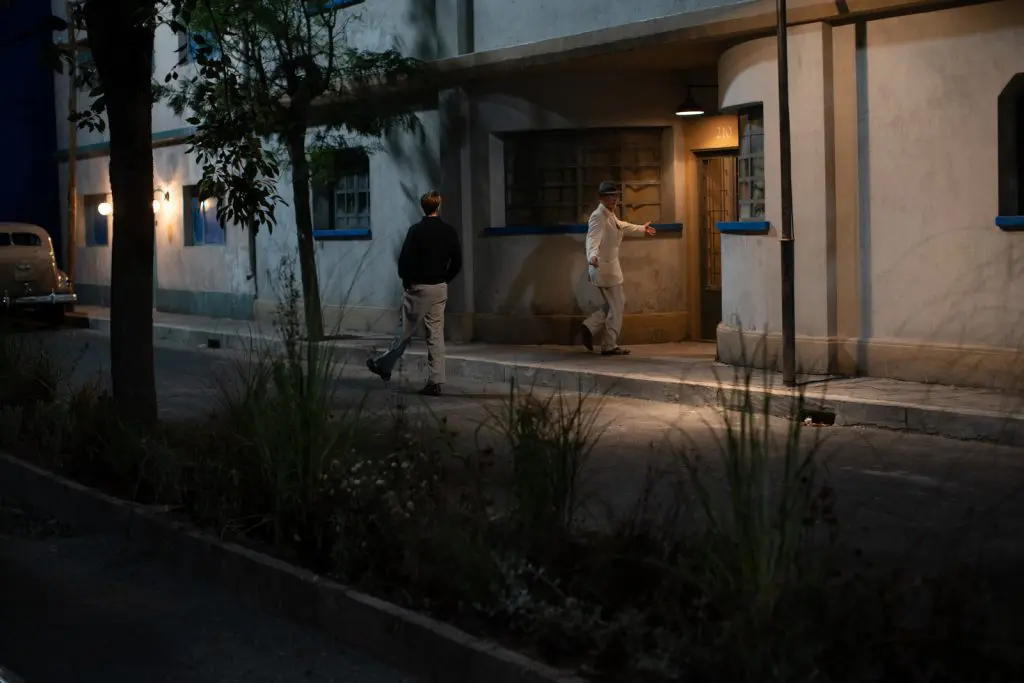
The film is filled with sticky, sweat-drenched scenes, evoking the heat of Mexico and the excess of tequila and mezcal. The street scenes—often of aimless wandering—are inspired by real locations, blending colonial, deco, and modernist architectural styles. The design of Queer carries the feel of mid-century Hollywood studios, with a deliberate choice to make the world of Queer artificial—reflecting Burroughs’ imagination rather than adhering to a traditional period drama. Everything was created and shot Cinecittà Studios in Rome.
Guadagnino notes the importance of creating a world that is both historically accurate and deeply emotional. “Mexico has a history of welcoming refugees and political dissidents, like Trotsky, who left a mark on the place,” he explains. “But we also had to stage Burroughs’ world as a projection of his total imagination.” This ambitious vision was realised through a collaboration with Baisi and art department team, whose approach reflected the idea of cinema as a tool to play with space—turning it into a mirror, a box, or a canvas, evoking the powerful connections between characters.
William Lee’s Apartment
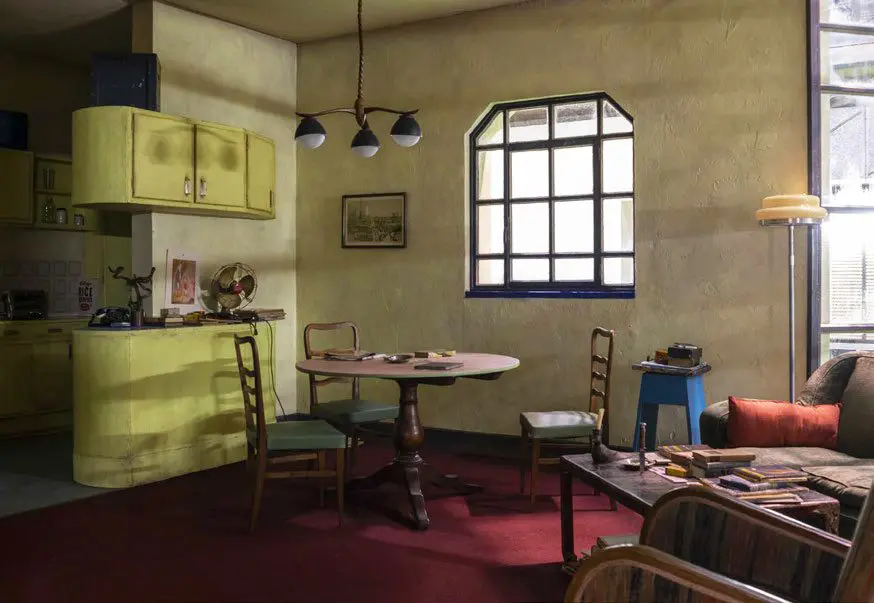
William Lee’s apartment is an important set in the film. It’s a space where his emotional state is reflected in the design—sparse, lonely, and claustrophobic. “We started from the description in William Burroughs’ novel,” Baisi explains, “it is described as a quite empty apartment with the furniture that seems to come from the street or from something that was secondhand.” This sense of isolation is emphasised by the rich colours that dominate the space—deep red carpets and furniture that feels well used.
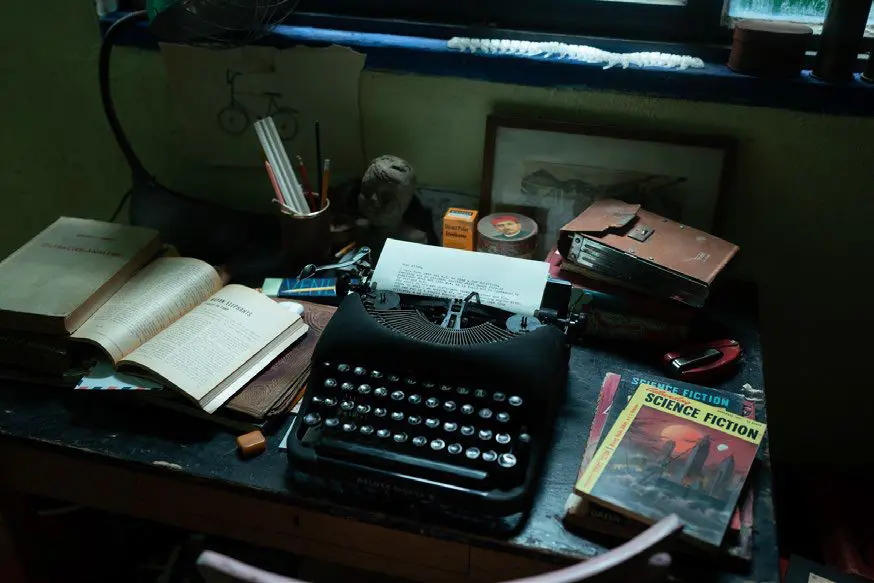
Baisi’s goal was to create a space that reflects Lee’s inner conflict. The furniture in the apartment mirrors the character’s failure to live up to his own expectations. “The beat generation was a generation of poor writers, so there wasn’t a lot of wealth in what we studied,” Baisi adds. The choice of furniture, often mismatched and worn, together with props such as the typewriter and carefully chosen Science Fiction magazine reinforces Lee’s struggles with identity.
-
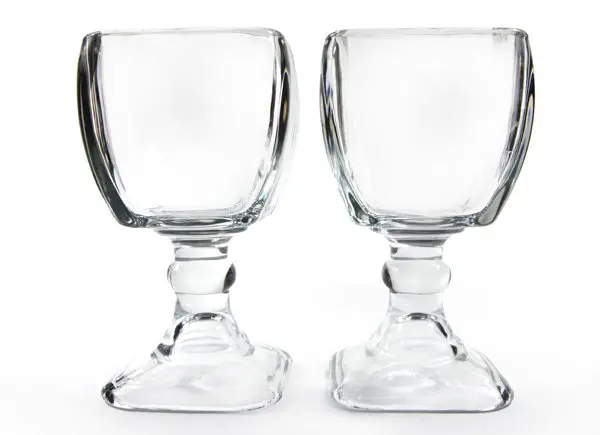
Mexican Copa Chabela Cuadrada (square glass) as seen in Rick Stein’s Road to Mexico
As seen in:Shop NowThe large Copa Chabela Cuadrada square Mexican beer glass in Rick Stein’s Road to Mexico is made from super thick glass to keep liquid contents cold.
Approx Price range: £44.00 through £164.00 Inc VAT if applicable / $58
A collection of iconic cafés, bars, hotels and dining spots
There’s a lot of drinking, waiting, and watching in Queer, which leads us to several atmospheric bars and restaurant spaces.
Ship Ahoy
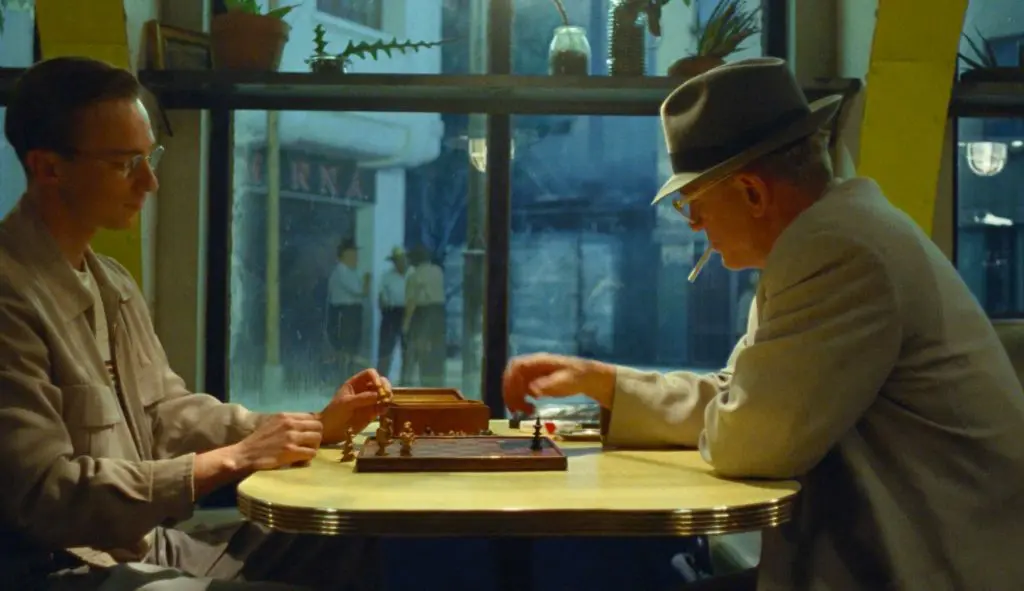
Ship Ahoy, a café frequented by Lee and other characters, is an eclectic mix of nautical elements and 1950s American diner style. Inspired by a real place—the Bounty Bar—and its upstairs apartment, where, in 1951, Burroughs accidentally killed his wife, Joan Vollmer, during a tragic game involving a gun that he himself described as a ‘William Tell act.’
Drawing from eclectic references ranging from Wolfgang Tillmans’ Still Life series to the the famous ocean liner SS Normandy, the design of Ship Ahoy reflects the transient, expat vibe of its patrons. “We thought the best way to design Ship Ahoy was to think about Tom Weston, the café’s owner, who might have taken pieces from boats to create the space,” Baisi explains.
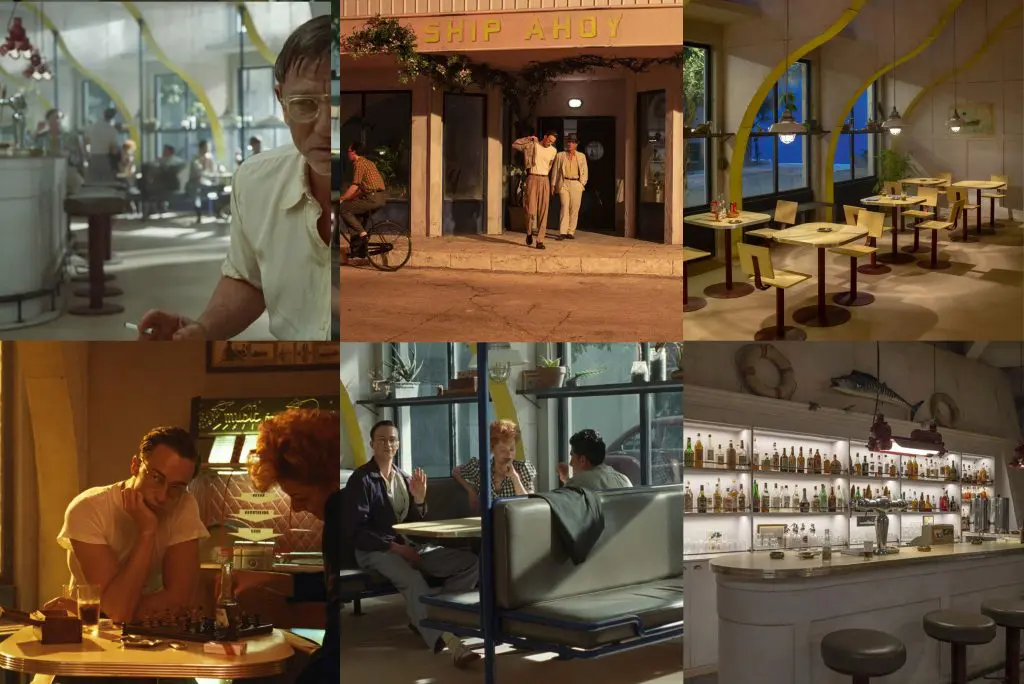
The café features a port hole windows, bright yellow bar countertop, square-backed chairs, and booths with padded grey seats, giving it a slightly worn and utilitarian feel. “It was frequented by expats, so we thought it could be more American than Mexican,” Baisi explains. This melding of styles creates a visually striking space that adds to the film’s sense of detachment from reality.
-
Mexican Copa Chabela Cuadrada (square glass) as seen in Rick Stein’s Road to Mexico
As seen in:Shop NowThe large Copa Chabela Cuadrada square Mexican beer glass in Rick Stein’s Road to Mexico is made from super thick glass to keep liquid contents cold.
Approx Price range: £44.00 through £164.00 Inc VAT if applicable / $58
KC Steakhouse
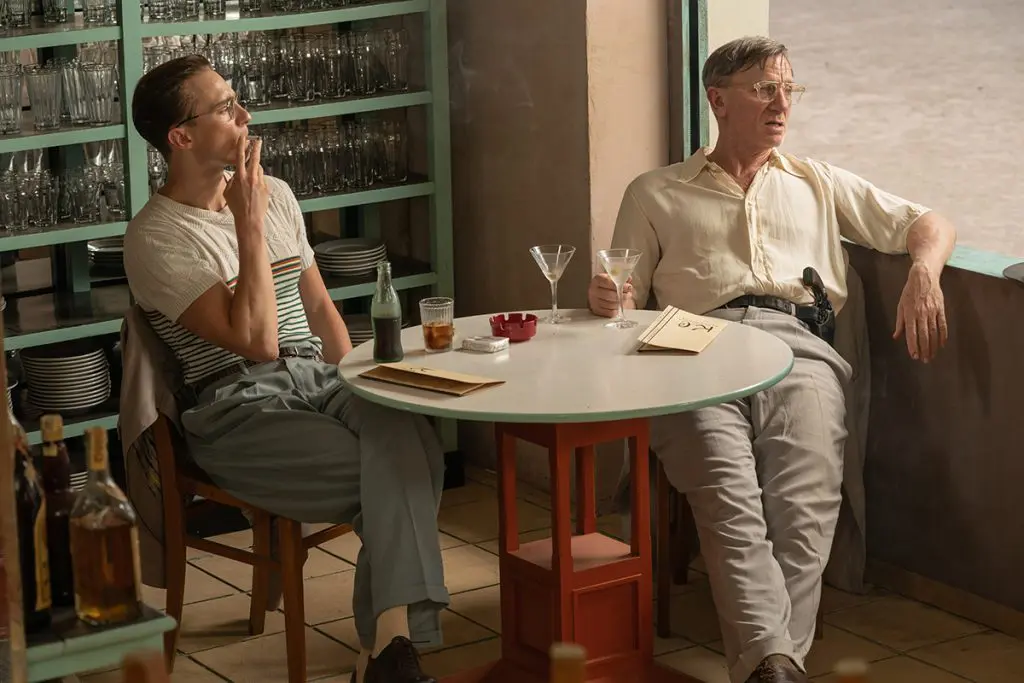
Another notable location is the KC Steakhouse, a café with a distinctly Mexican atmosphere. “We started designing that set influenced from a painting by Francis Alÿs,” Baisi says. The use of pistachio green shelves and a deep red table with green trim creates a traditional Mexican feel.


Lola’s
Lola’s Cantina blends Soviet and Mexican design elements. “We mixed two locations described in the novel—the Russian restaurant and Lola’s itself,” says Baisi. The cantina’s symmetry is emphasised by a central pillar, with large mirrors surrounding it to reflect the dualities of the characters’ lives. The design incorporates Russian avant-garde art, making the space feel both foreign and familiar, a fitting backdrop for the film’s themes of longing and cultural conflict.
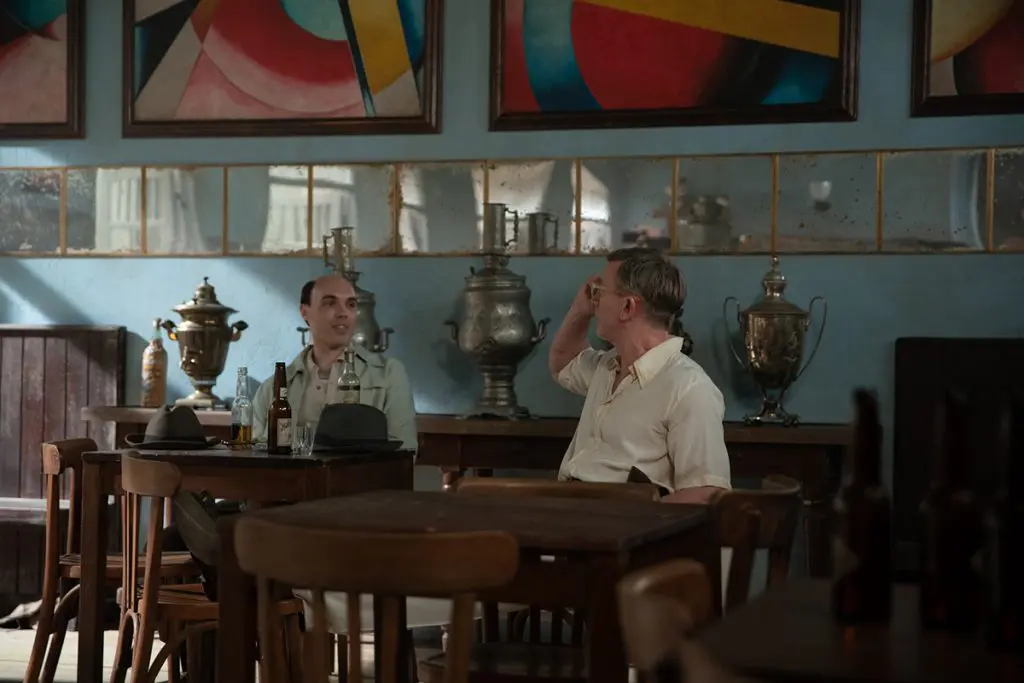
You’ll also see a number of samovars (a metal container used to boil water for tea). Originating from Russia, samovars are often decorated and are considered a symbol of hospitality.
Hotel and Chimu Bar
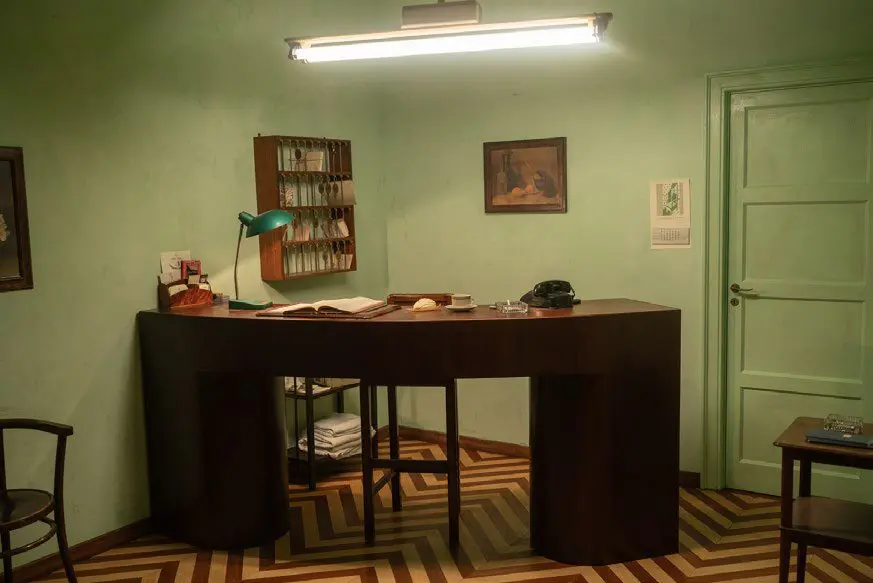
Another significant location in the film a dingy hotel where Lee stays. The hotel’s design complements the film’s sense of alienation and displacement, with sparse, uninviting rooms.
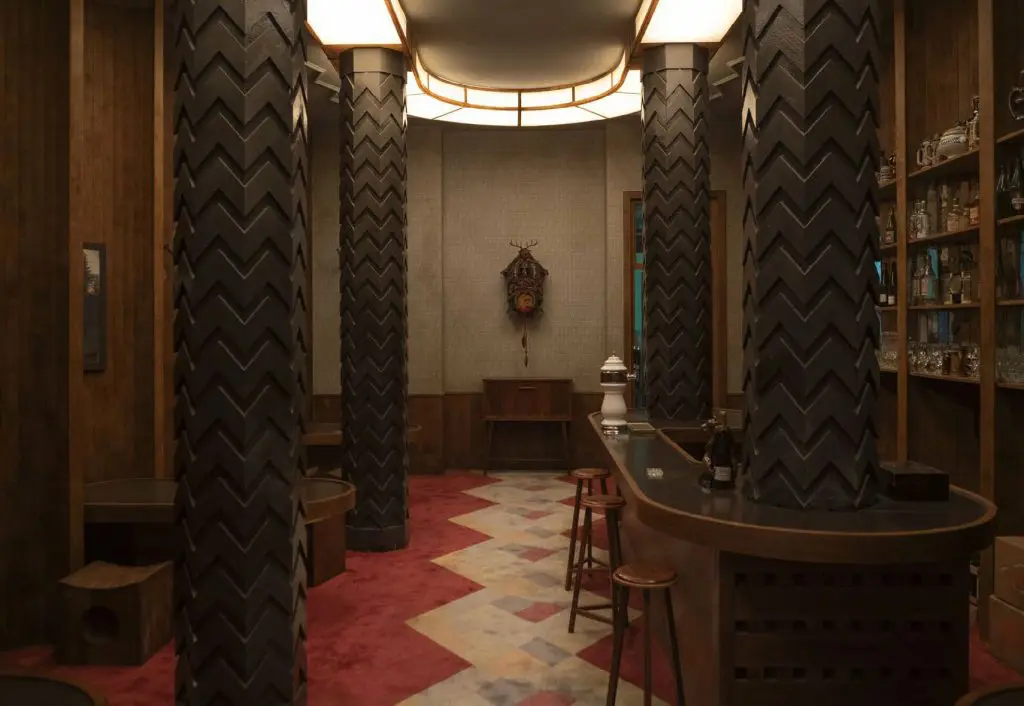
The Chimu Bar, a gay club which also appears in the film, is designed with symmetry and minimalism in mind. Baisi worked to make the bar feel as though it was repurposed over time, capturing the essence of a place that had evolved and changed alongside its patrons.
The use of materials and muted colours in these spaces further underscores the film’s focus on isolation and the disconnection between characters. “We tried to create something that wasn’t real but felt emotionally authentic to the characters,” Baisi explains.
The Rathskeller
Inspired by the underground beer cellars Burroughs frequented in Vienna—places he described as “dusty and frozen in time”—the Rathskeller in Queer evokes a sense of nostalgia and decay. Although there is no historical evidence that such a Germanic haunt ever existed in Mexico City, Stefano Baisi imagined it as a hall revolving around the central axis of a bar, flanked by a row of hexagonal columns featuring geometric motifs reminiscent of the work of architect Adolf Loos.
Continuing with the artificiality that permeates the design, many of the plants seen in the exteriors were carefully constructed to simulate the hazy blue of the jacarandas swaying in the breeze. Rows of fake trees were strategically placed to steep Lee and Allerton in the desperate romanticism of these flowers, reinforcing the film’s dreamlike atmosphere.
The Movie Theatre
When Lee and Allerton go to see Orpheus by Jean Cocteau, Baisi designed a cinema that evokes the 1940s movie theatres of Mexico City, while incorporating elements from Vienna, a place Burroughs had visited a decade earlier and that left a lasting impression on him.
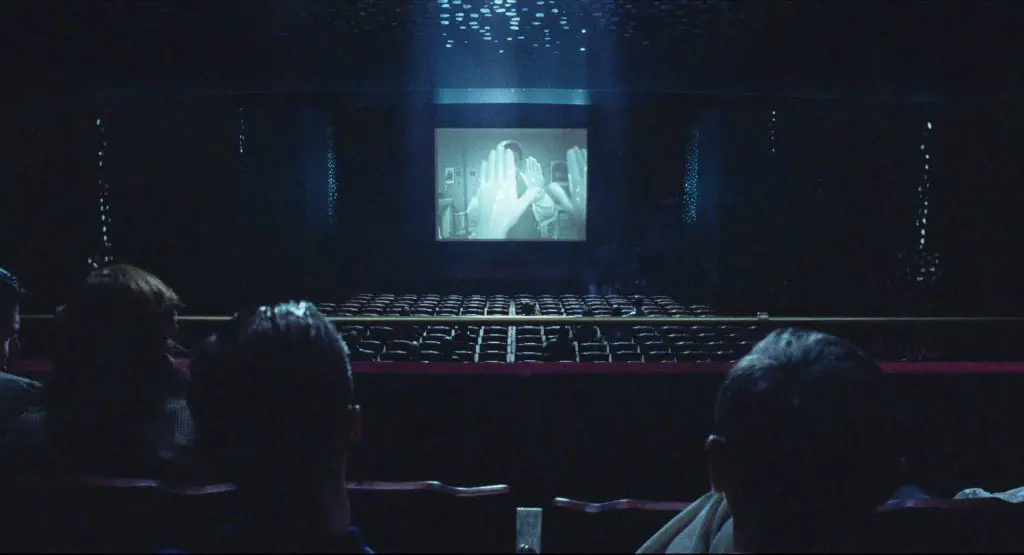
The cinema set itself was designed with varying dimensional scales, gradually shrinking as the camera’s gaze approached the screen. The sequence begins with real spectators, then transitions to a smaller screen, where tiny viewers stand, all brought to life with the help of miniatures and digital technology. “We wanted to reduce as much as possible the digital extension,” Baisi explains. “We used miniature sets for the first few rows of seats, with everything else being fake.”
The Jungle and Dr. Cotter’s Hut
One of the most challenging and imaginative sets is the Ecuador jungle hut where Lee and Allerton go in search of Ayahuasca and where Dr. Cotter (Lesley Manville) conducts her research. The team recreated the jungle on a studio lot in Cinecittà Studios, hiring a botanical expert to ensure the plants were accurate to Ecuador’s native flora. “We mixed real plants with fake plants and trunks to create an authentic but fantastical space,” says Baisi.
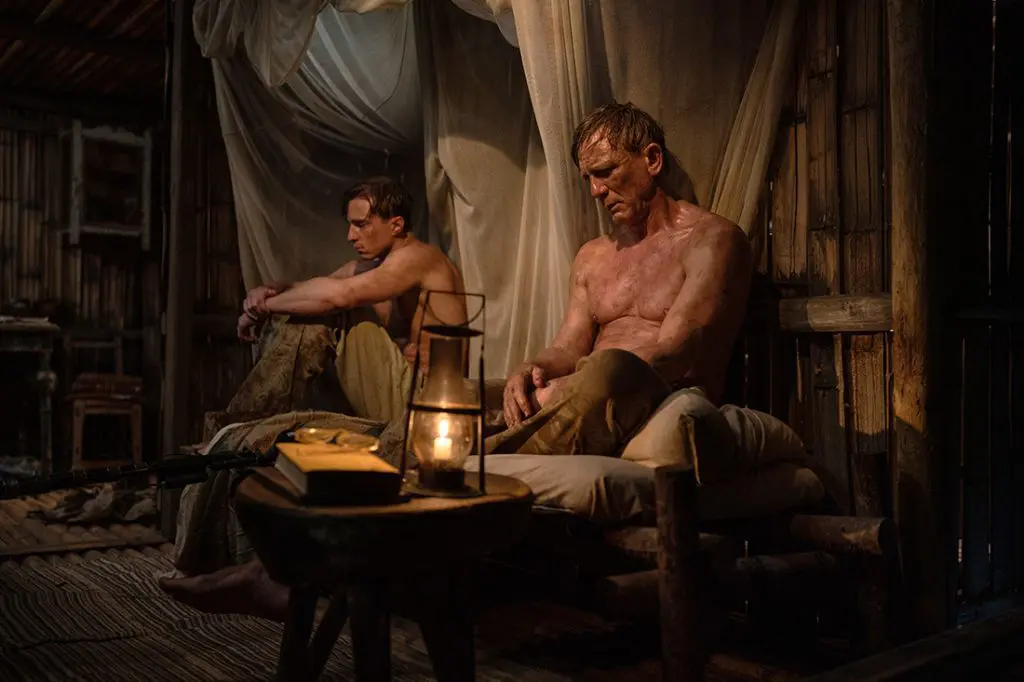
The design of Dr. Cotter’s hut adds another layer of complexity, with the idea that it was once part of an abandoned oil company outpost. “We imagined Dr. Cotter finding an abandoned hut and transforming it” Baisi explains. The use of metal and natural materials helps convey the isolation and transformation of the setting, underscoring the characters’ inner journeys.
The Art and Film References in Queer
Throughout Queer, Guadagnino and Baisi drew inspiration from a wide range of artists and films to craft the film’s aesthetic, which blurs the boundaries between reality and fantasy. Guadagnino envisioned the film as a moving painting, with the set design reflecting a carefully curated visual language that would evoke emotions through every frame.
From artists Michael Borremans, Francis Alÿs, Francis Bacon and Rachel Whiteread, to film makers Akira Kurosawa and David Lynch, you can read more about the art and film references in Part 2 of investigation into Queer.
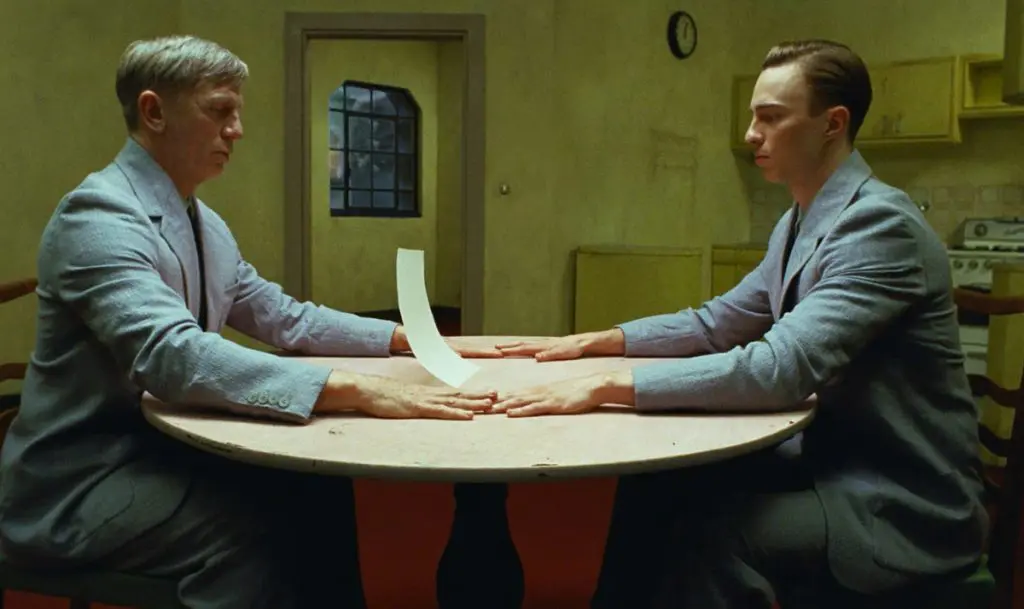
Through Guadagnino’s vision and Baisi’s meticulous work, the production design of Queer is more than just a backdrop for the story—it becomes an emotional landscape that reflects the inner worlds of the characters. From Lee’s lonely apartment to the surreal Ship Ahoy café, every film set and piece of furniture and decor is a carefully constructed element that amplifies the themes of longing, desire, and emotional conflict.
This feature is FREE to Classic members.
Join our newsletter community to receive Film and Furniture inspiration direct to your inbox and we’ll UPGRADE you to Classic Membership (which includes access to our exciting giveaway draws) for FREE.





 Facebook
 Twitter
 Instagram
 Pinterest
 RSS
RSS